
Asiafuturism
South korean sculptor, installation artist and performance artist Lee Bul.
Anyone remember Richard Stanley’s under-the-radar 1990 dystopian sci-fi film Hardware? About a guy who scavenged the wasteland and brought home various metals and industrial bits and bobs he found on his travels to his artist girlfriend? Well, if ever there was a real life complement to that film’s post-apocalyptic sculptor it might be South Korean sculptor, painter, installation artist and performance artist Lee Bul. A major contemporary artist that nonetheless flies under the radar for some, probably too many, the daughter of political dissidents emerged in the 1980s and made a mark for tackling the ebbs and flows of South Korea’s rapidly (at the time) shifting and often dangerous sociopolitical environment. It was the time of the Seoul Olympics, but the country’s first elections since it was locked down by dictatorship in the 1960s were still years away.
Lee Bul: From 1998 to Now, a collection of over 200 sculptures, paintings and maquettes spanning Lee’s 40-year career is, “Really about time and space travel, to different eras and different civilisations. It’s a grand vision, contemplating humanity and our past and future, as well as the present,” says Doryun Chong, M+ artistic director, chief curator and exhibiton co-curator along with Leeum Museum of Art director Lee Seo-hyun. While Lee’s work interrogates where we came from and where we may be going, she is rooted firmly in the here and now. “Contemporaneity is the capacity to see multiple layers of different times all together within the present,” she said at M+ ahead of the show’s opening on March 14. “And when we begin to read these traces, we arrive at one simple yet joyful realisation: The world is not merely a place we live in. It is something we read.” And as read by Lee it’s wild and speculative and fabulously undefinable.
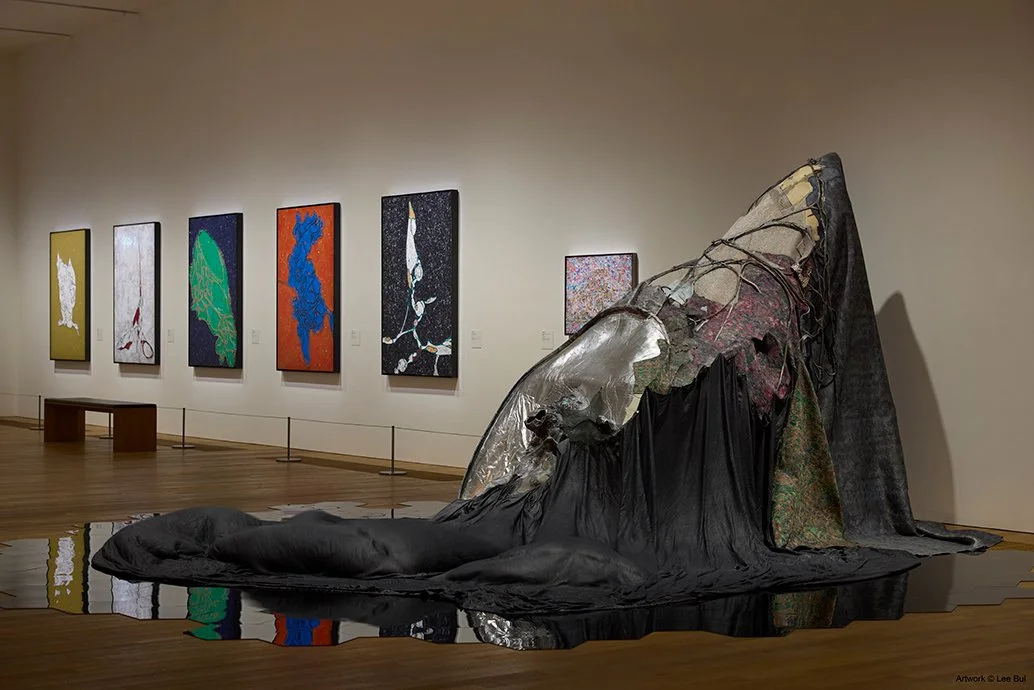
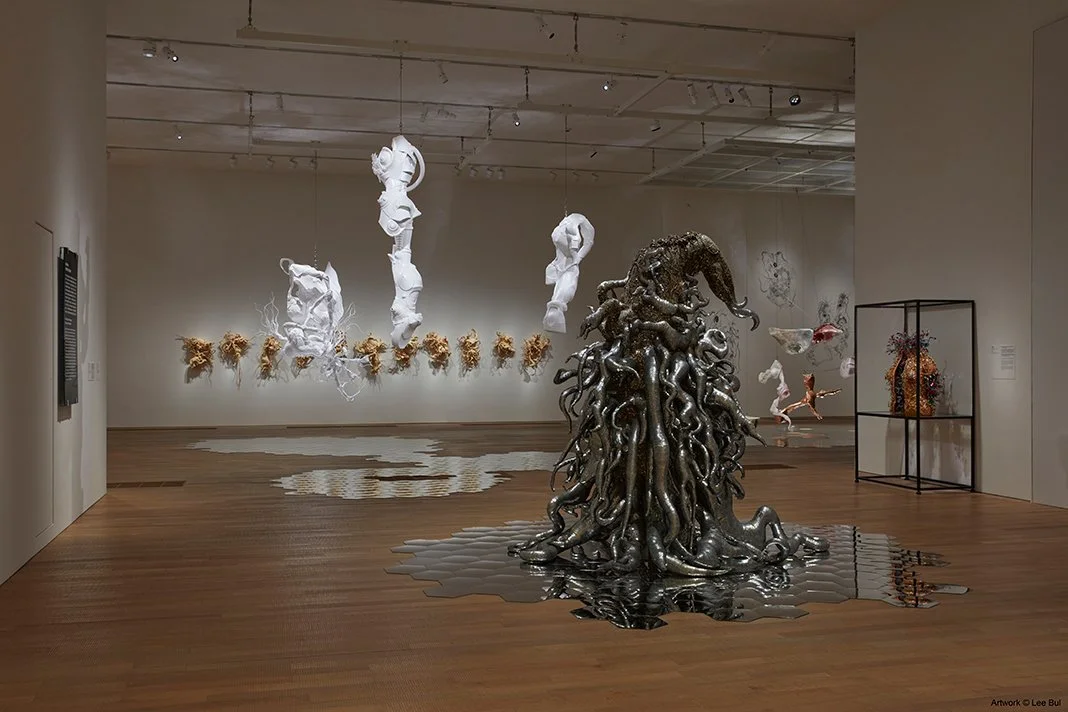
Broken into three chapters, Lee Bul: From 1998 to Now clocks Lee’s evolution as an artist as well as how her focus jumped among subjects, from her first performance art on Tokyo streets (Sorry for suffering-You thinkI’m a puppyon a picnic?), to the minutiae of humanity through the lenses of urbanism, gender and power dynamics. Lee’s early work (referenced in the show) explored ideas of beauty and decay, but she “Moved on to thinking about bigger forces and issues that affect all of us: the body and society, humanity’s relationship with technology and nature, and civilisation, and how our lives are governed by the mechanisms and structures of power,” notes Chong. “Looking back, it’s really incredible how prescient her interests were.”
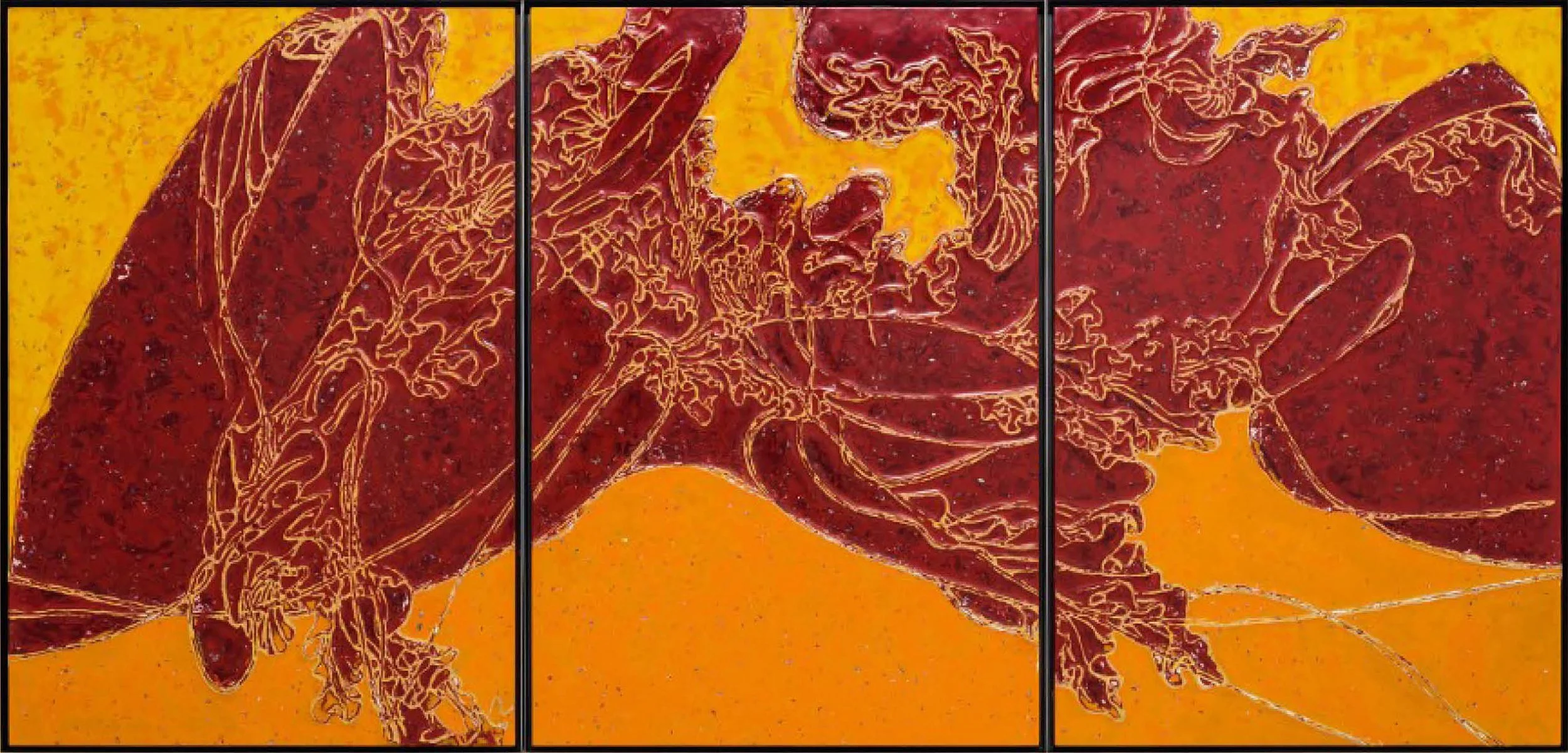
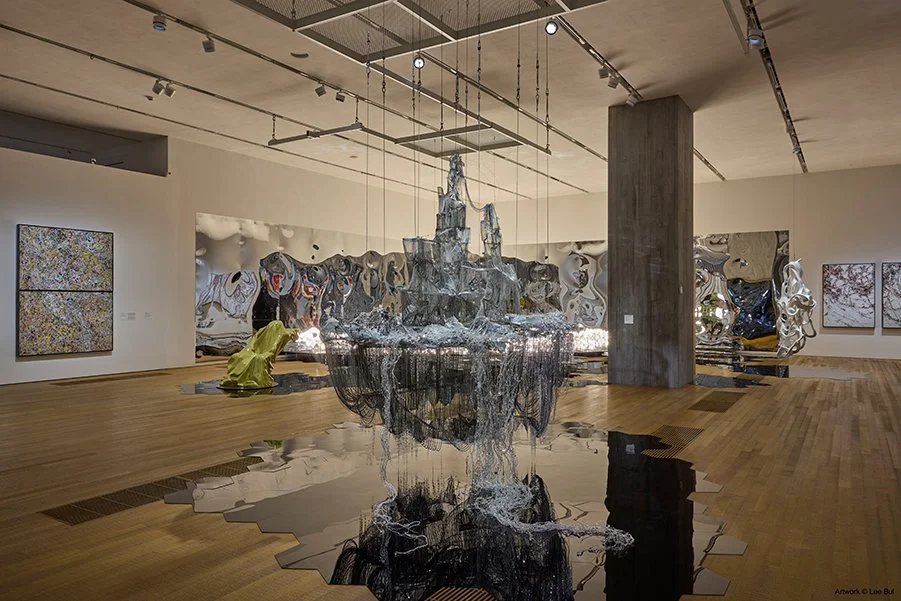
The first chapter covers, essentially, last 20 years of Lee’s ongoing output in “Landscape of Utopian Dreams: Mon grand récit and Perdu” the former concentrated in installations, the latter being mostly 2D paintings. “You can think of them as kind of microcosmic landscapes in themselves,” explains Chong. “We wanted these sculptures of varying scales and materials, constructions and methodologies, to speak to one another without being impeded by any temporary walls, which is why we adopted this open plan.” Tactile and often interactive pieces in this section are the most compelling, using unconventional materials, such as mother of pearl – mixed into acrylic paint, applied in layers on a wood base and then scratched off to excavate the hidden dimensions, such as in the three-panel Perdu XXV (bottom, left) – glass, stainless steel, paper, plastic and fabrics. We’re forced to engage with ourselves thanks to reflective surfaces, be it inside Souterrain or in front of the Cthulhu-esque Monster: Black (above, right).
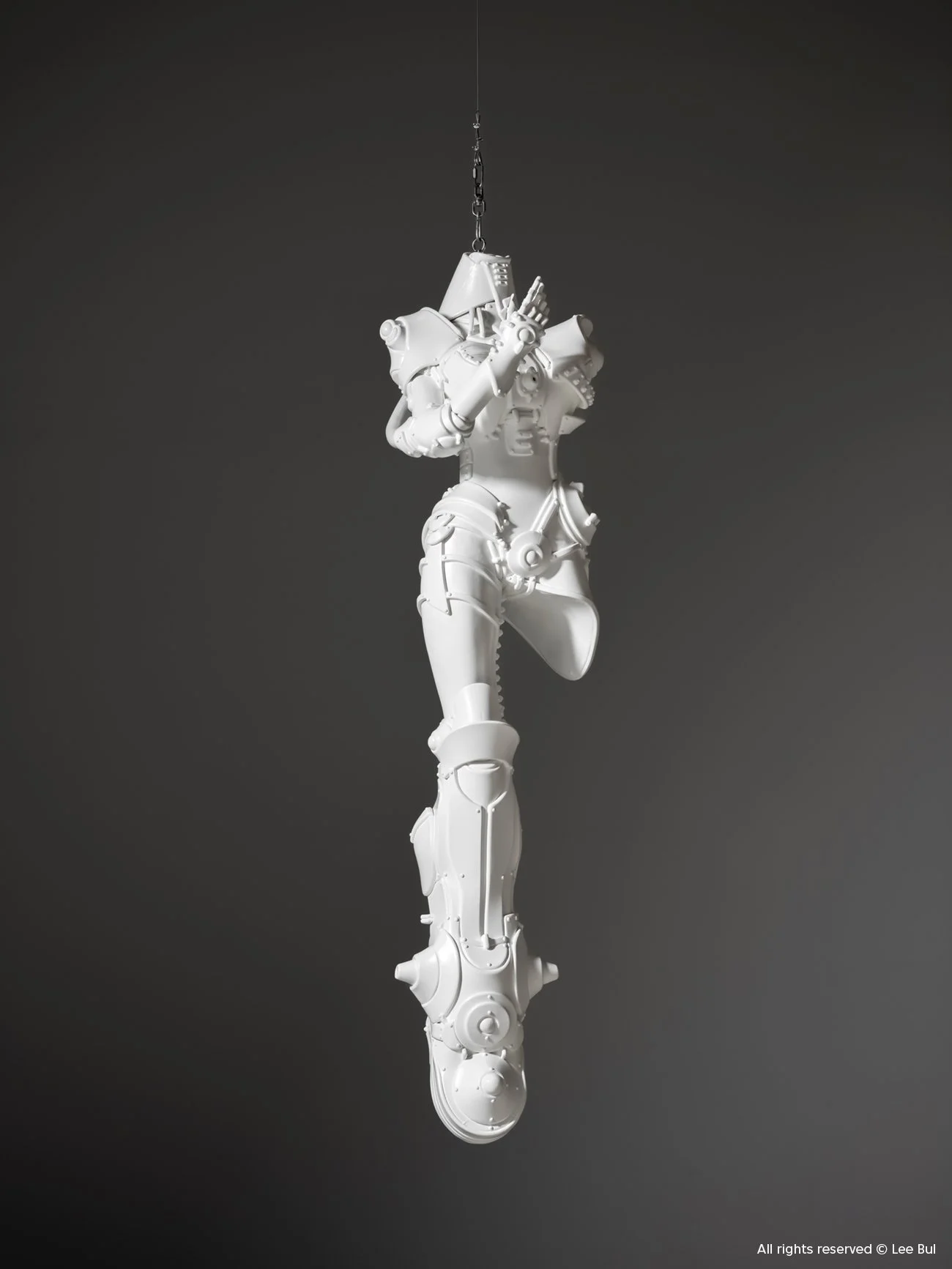
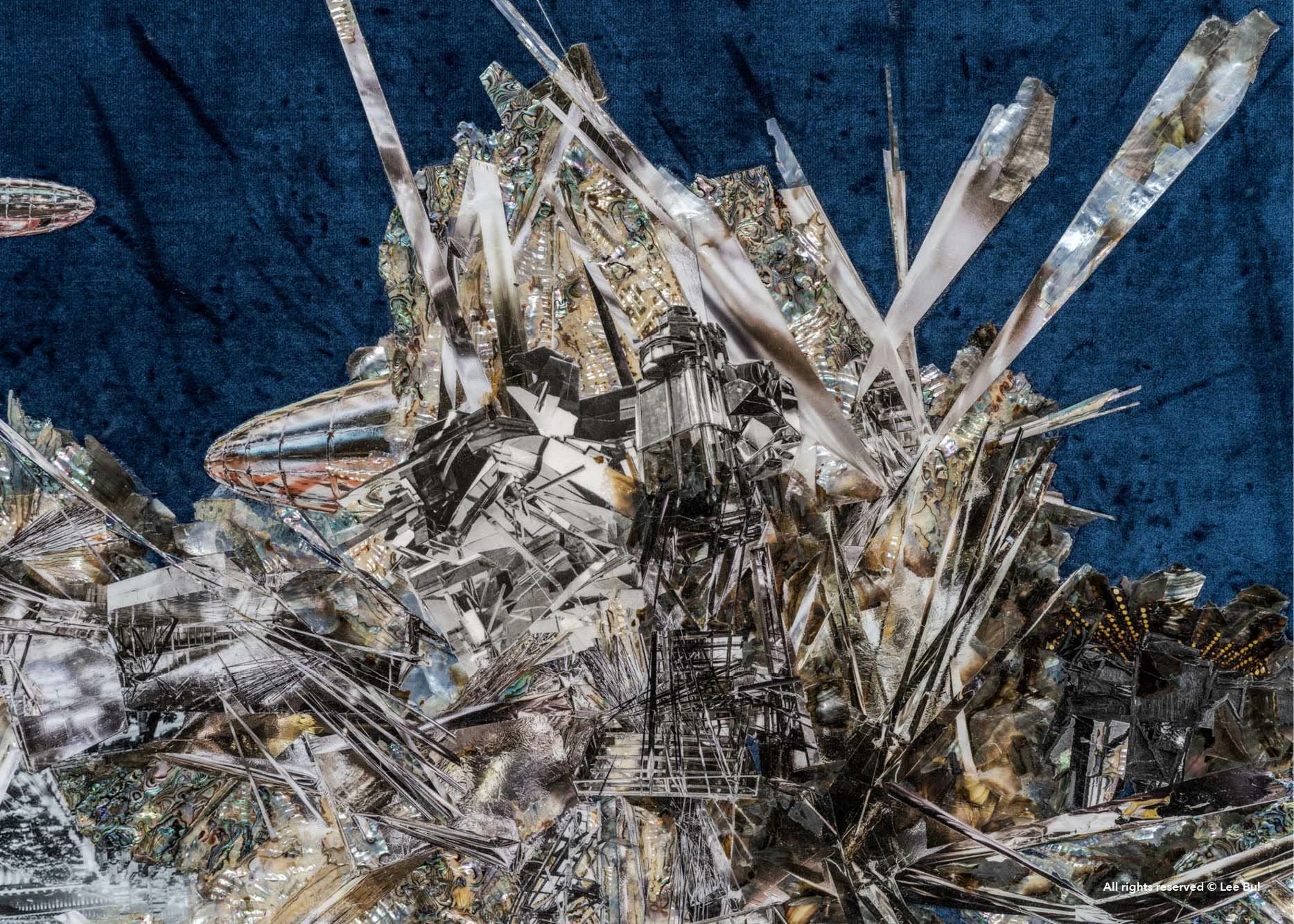
Chapter two, “The Body and Technology: Cyborgs and Anagrams” dives into Lee’s older sculptures, many exploring human physicality as it relates to technology in pieces like Cyborg W6 (above, left). “They have certain organic and biomorphic quality, a different kind of ornamental language,” Chong points out, of the series that also interrogates gender perceptions; they’re missing heads and arms for a reason. The hanging sculptures are the natural evolution of Lee’s integration of soft sculpture as a prop or as an extension of her body, like the ones on Sorry for suffering. “These aren’t just for the sake of representation of the human body, but as a way of contemplating its destiny with the relentless advancement of technologies,” we’ve come to accept as truths Chong says of perhaps the most persistent motif within Lee’s body of work. The installations teem with references to urban theory (below, right) such as German architect Bruno Taut’s Alpine Architecture project, and double down on the fantastical and deceptive elements inherent in utopian thinking. “I don’t think she’s interested in binaries at all; in correct or not, in utopian or not. I think what she’s interested in is the cyclical pattern that has driven human society and civilisation in general.”
Finally, chapter three is “Inside the Artist’s Mind” and it compiles roughly 100 maquettes, sketches and drawings in a faux workshop, detailing Lee’s process and demonstrates, as best it can to outside observers, how she moves from abstracted idea to final art piece. At just over 60, Lee’s work deconstructing our collective desire and constant search for perfection – societal, intellectual, physical – still resonates because we haven’t evolved past those desires. But even if you don’t pick up what Lee throws down, wandering her neo-industrial, agitator’s mindscape is a worthy trip in itself.
Lee Bul: From 1998 to Now
Where: M+, West Gallery
Hours: Through August 9 2026, 10am-6pm; Fridays 10am-10pm
Closed: Mondays
Details: Tickets HK$190; students, seniors 60+, children 7-11, CSSA recipients HK$100. Information and full ticketing details at M+