
Pass
Xu Zhanxiong does nothing for the legend of the Chairman except suggest he had many bad hair days.
Crossing
Director: Xu Zhanxiong • Writer: Liu Yi
Starring: Liu Ye, Wang Lei, Yu Shi, Wang Zhifei, David Wang
China • 2hrs 1min
Opens Hong Kong July 1 • IIB
Grade: C-
It’s 1935, and the Chinese Civil war is raging. Bloody battle after bloody battle has the Central Red Army back on its heels, compelling military leadership to put Mao Zedong (Liu Ye, in his second crack at the Chairman after The Founding of an Army) at the top of the food chain to stop the bleeding. Along with Zhou Enlai (Wang Lei), he concocts a plan to go back and forth across the Chishui River to throw off the enemy led by Chiang Kai-shek (David Wang Yaoqing) and turn the tide of the war in their favour. This is all decided (well, most of it) at the Zunyi Conference, where we also meet a laundry list of historical figures, including Deng Xiaopeng, Zhang Wentian, Wang Jiaxiang and Peng Dehuai, for roughly 30 seconds. Early on, it is nigh impossible to figure out what’s happening in Xu Zhanxiong’s Crossing | 四渡.
After an opening barrage of names, titles and ranks designed to establish the key characters, Xu hyperactive wannabe epic eventually settles into a standard A- and B-plot construction, precision-engineered for hero worship. One pivots on the long-distance tête-à-tête between Mao and Chiang, when Mao’s Red Army found itself outmanned and outgunned by Chiang’s KMT army by about 10 to one and facing an existential threat. The other revolves around the grunts on the front lines, among them Zhao Defa (Yu Shi, Blades of the Guardians), Zhu Huiyong (Wang Tianchen) and Guo Chuang (Wang Yutian), tasked with carrying out Mao’s plans and who adopt an orphaned boy, Ajin (Xia Zixuan), who grows into a proud Red Army soldier.
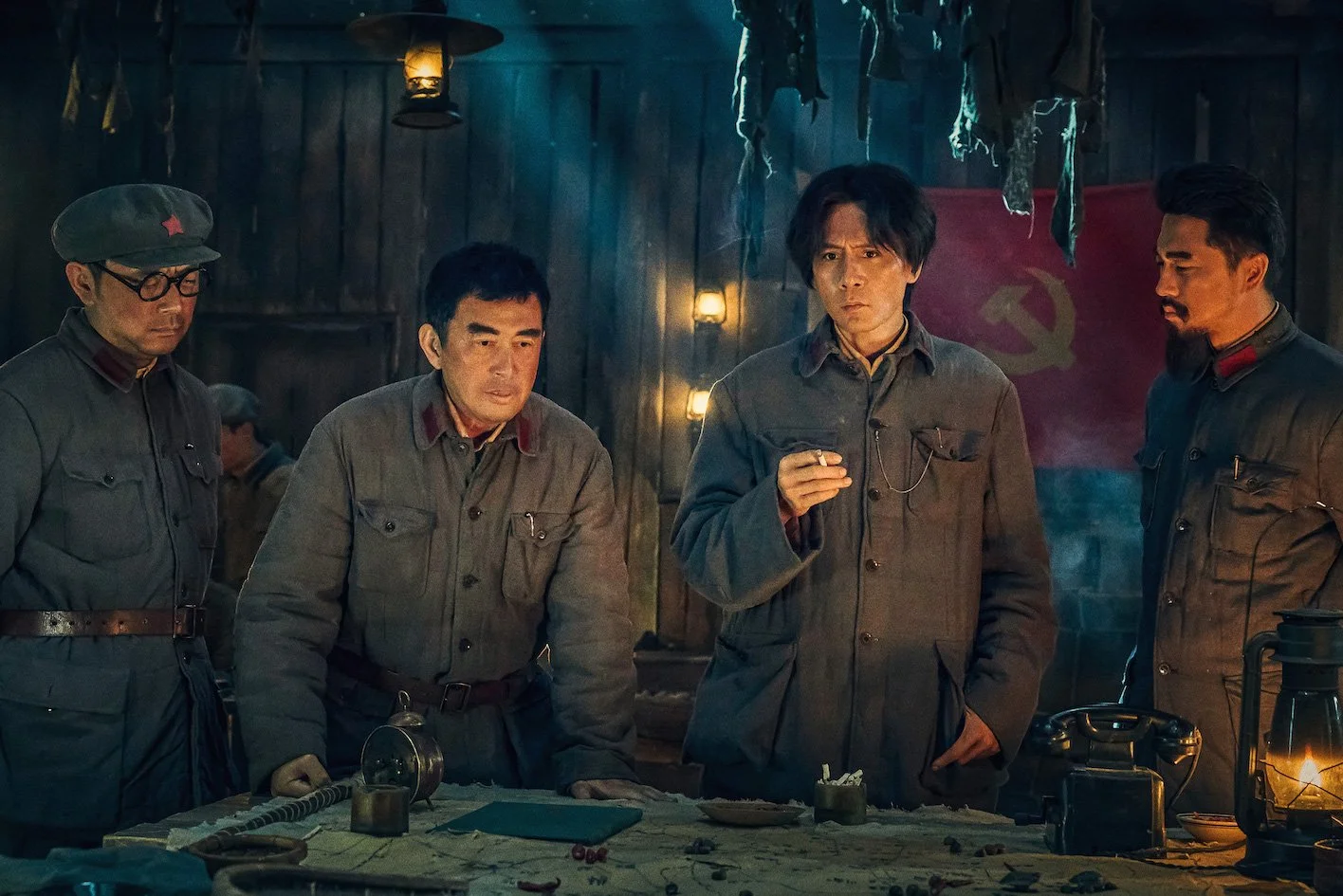
Time for a smoke
Produced by Andrew Lau Wai-keung (!) and written by Wolf Warrior scribe Liu Yi as if it were Wolf Warrior 3, Crossing is an exercise is unvarnished hagiography. After the battery of names – which are meaningless to anyone without a passing familiarity with 20th century Chinese history – Xu dives headlong into yet another battery of speed ramping, whip pans, people bursting through doors, pointing at maps, charging up hills and Mao having a smoke, edited so as to ensure barely a singe shot is held for longer than two to three seconds. This aesthetic mostly works for, oh, say, Wolf Warrior; here it’s a lazy substitute for legitimate storytelling. In an effort to include all four crossings and a complete breakdown of their planning, Liu crams so much into the script it renders the emotional beats the non-stop score tells us are critical utterly without value. When young soldier Bo Gu (Timmy Xu Weizhou) dies going up, of course, a hill, Guo is overcome with sadness, screaming a silent “No!” to the heavens. They were close; he’s lost a brother. Really? Because we saw him eat some nuts or something and paint a sign. Later, when Guo himself becomes a casualty of war, Zhao is is overcome with sadness, screaming a silent “No!” to the heavens. They were close; he’s lost a brother. Uh… sure. I must have missed that part. These Big Moments are unearned thanks to the anonymity of the soldiers, both as real people and as characters in a movie. The same can be said for the high command. Mao is a figure that’s been studied to death, so I guess it’s logical that Liu is uninterested in interrogating his motivations, his fears (I know, I know, he had none), his insecurities, or floating a theory about his rivalry with Chiang. Without a fresh take on the man, the myth and this moment in history there’s no reason to care. And sorry to be petty but Liu’s busted wig is distracting, even within the context of a gaudy, career low performance.
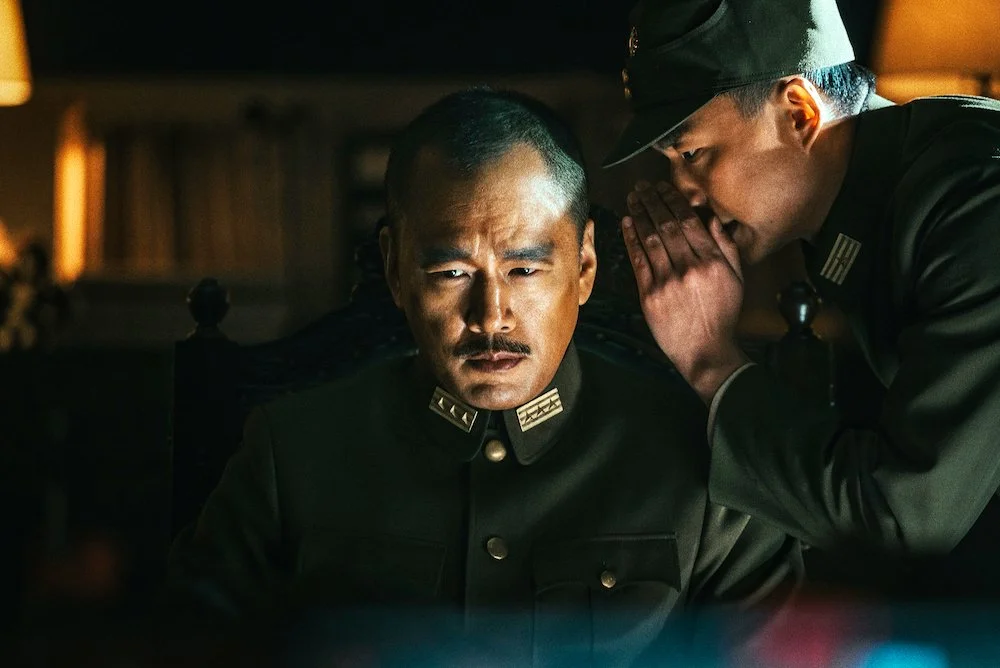
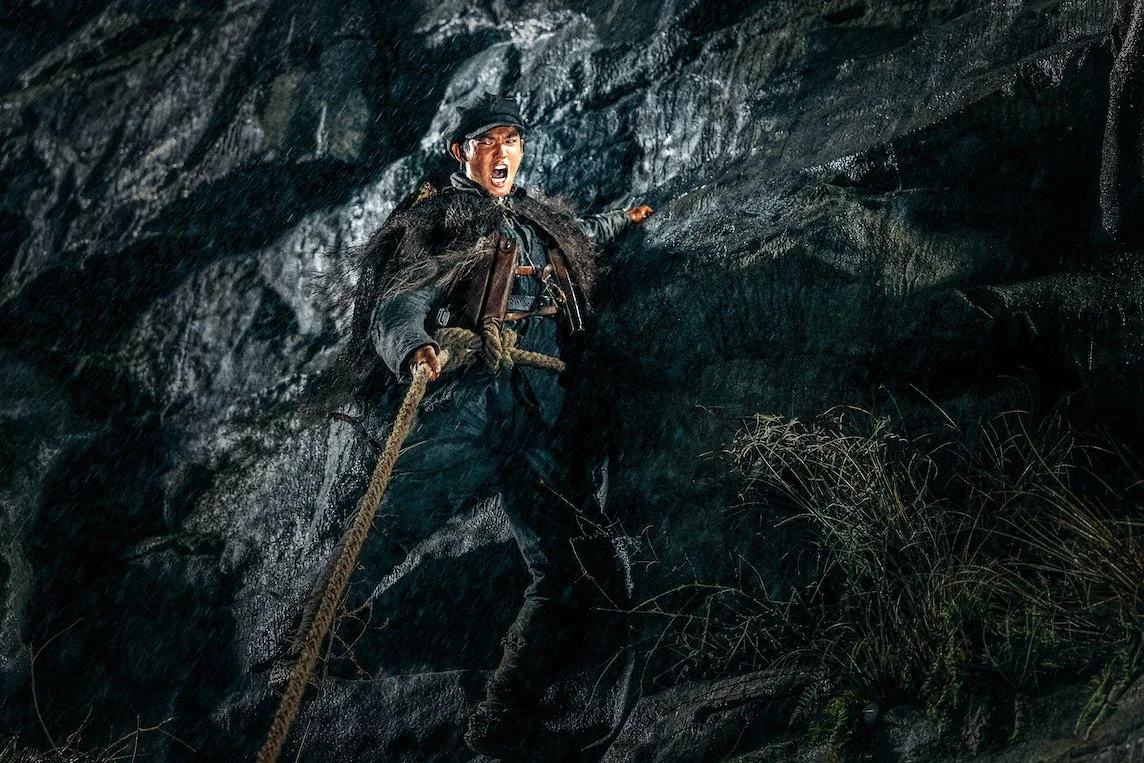
Going out on a limb, what is seems Liu and Xu wanted to do was tease out a cat-and-mouse war thriller in which two of history’s great strategists goad each other, challenge each other and outwit each other in their individual quests to win over the soul of an emerging nation. What they achieved was a frantic mess of battlefield explosions, flying dirt, mangled flesh and unearned tears that lands with a thud and does next-to-nothing… check that, nothing to illuminate the men (there’s one female medic in the movie, a few shop owners that donate their doors to the cause, a Soong sister and Madame Chiang) at the centre of the action. Crossing is based on an actual moment in history, which neither ensures veracity nor as a film demands it, and The Four Crossings of the Chishui River is a pivotal benchmark for the PRC, making it the ideal jumping off point for modern examination, recontextualisation and reconsideration. Instead Crossing is all logistics, no guts, and ends up as just another splashy, big budget echo chamber that doesn’t even have the cinematic gloss of Dongji Rescue or The Eight Hundred given its lumpy pacing – map tent, noisy battle, map tent, noisy battle – and janky CGI. Toeing the line is fine, but sloppy filmmaking is unforgiveable.