
Still Hell
Your ears will ring and your guts will jiggle in Alex Garland’s second trip into a war zone.
Warfare
Directors: Alex Garland, Ray Mendoza • Writers: Alex Garland, Ray Mendoza
Starring: D’Pharaoh Woon-A-Tai, Joseph Quinn, Will Poulter, Cosmo Jarvis, Charles Melton
UK / USA • 1hr 35mins
Opens Hong Kong April 17 • IIB
Grade: B+
As a friend and fellow critic so succinctly described it after watching Alex Garland and solider-turned Hollywood military advisor-turned director Ray Mendoza’s Warfare: Nothing happens, nothing happens, nothing happens, oh shit something happens, oh fuck oh fuck oh fuck oh fuck oh fuck oh fuck oh fuck oh fuck!
That is by no means a slight on the film, an ultra-immersive short, sharp shock of a war thriller that’s singularly committed to toning down the thrills. Focusing on a platoon of Navy SEALs in Ramadi, Iraq in 2006, a location crucial to counterinsurgency and site of multiple battles during the Iraq War, the script draws from the recollections of the soldiers who were there, warts and all. Mostly warts. Anyone who was frustraged by Garland’s abject refusal to label the players, illuminate the inciting incident, create clear sides of right and wrong or, above all, take one in Civil War will probably be equally frustrated by Warfare. Like the earlier film that lack of heroes, villains and easy answers is entirely the point. If you don’t feel as entirely bereft and confused as the film’s “enemy” combatants and “insurgents” do in Warfare’s brilliant closing shots I don’t know what to tell you other than you probably have no soul.
Not only does Warfare work as an efficient anti-war treatise, it’s a prime example of formal filmmaking and all the demonstration anyone should need of how the perfect convergence of performance, image and sound can come together to tell a story in perfect harmony with its themes. If editor Fin Oates (How to Have Sex), supervising sound editor Ben Barker (Ex Machina, Wonka) and cinematographer David J Thompson in essentially his first feature as DOP don’t get some major awards love a long eight months from now there is no justice and 2025 truly is a hellscape.
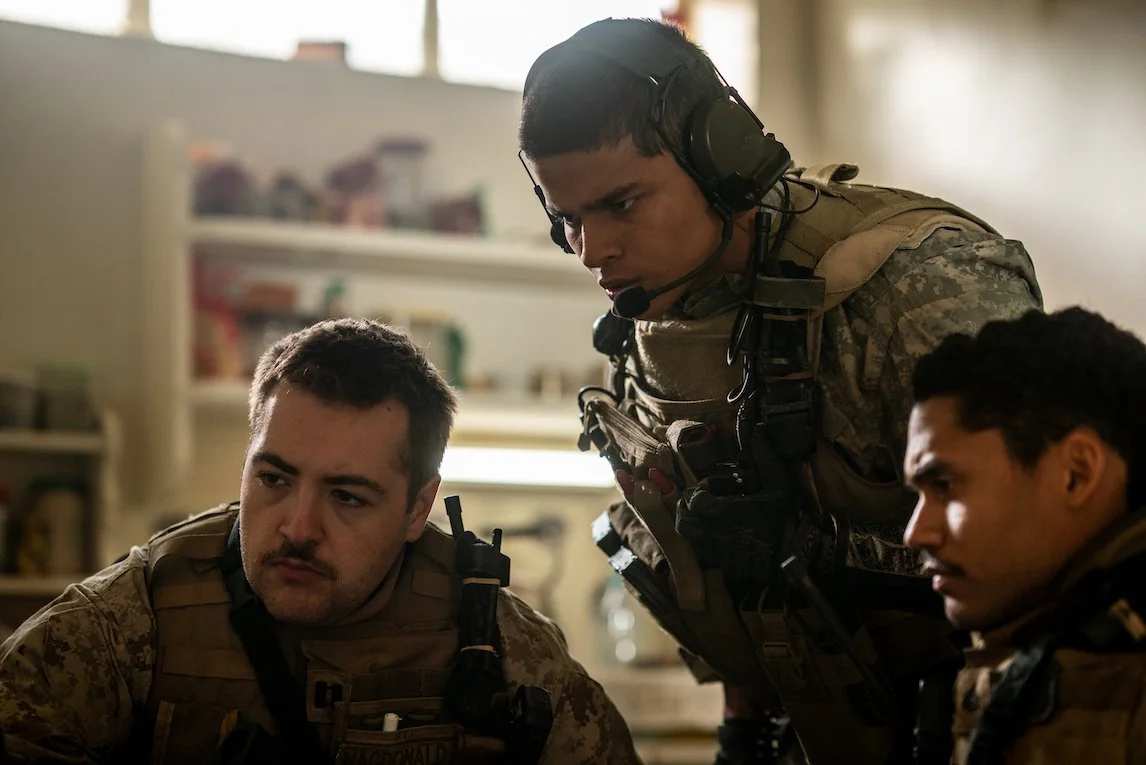
The ‘nothing’ part
If that weren’t enough, Warfare is brimming to the gills with every 25-35 actor Hollywood would like to see “happen”, the major selling point here being that all of them turn in vivid performances without hogging the spotlight and understanding their part in the bigger picture. After a broad intro to Alpha One and Alpha Two in the barracks, where they’re enjoying the retro ’80s cheeseball video for Eric Prydz’s “Call on Me”, the action smash cuts to the silent streets of Ramadi late at night, where the squad selects the house it’s going to commandeer in order to stake out a market across the street. Despite the house being occupied by two families, Alpha One moves in, with communications officer Mendoza (D’Pharaoh Woon-A-Tai, Reservation Dogs) monitoring the area with air support; sniper Elliott (Shogun’s Cosmo Jarvis, who somehow Garland made interesting) taking up a position behind his rifle at the window; his back-up, Frank (Taylor John Smith, Where the Crawdads Sing) in the room with him; and Sam (Joseph Quinn, Gladiator II, Stranger Things) and commanding officer Erik (Will Poulter, Guardians of the Galaxy Vol. 3) being gernerally soldiery. They sit around, make notes, fuck with each other’s water, wander, daydream. As Mendoza paints it, being a SEAL has little to do with badassery and more to do with paperwork and waiting around.
But then something does happen, the so-called “enemy” (Al-Qaeda insurgents) attacks and all hell breaks loose. The squad loses one of its translators, takes serious injuries, fails at a rescue by tank, and Erik suffers injuries that can’t be seen, but which make it difficult to command. Alpha Two, led by Jake (Charles Melton, May December), comes to Alpha One’s assistance. If the first half of Warfare was achingly dull, the second half simply aches.
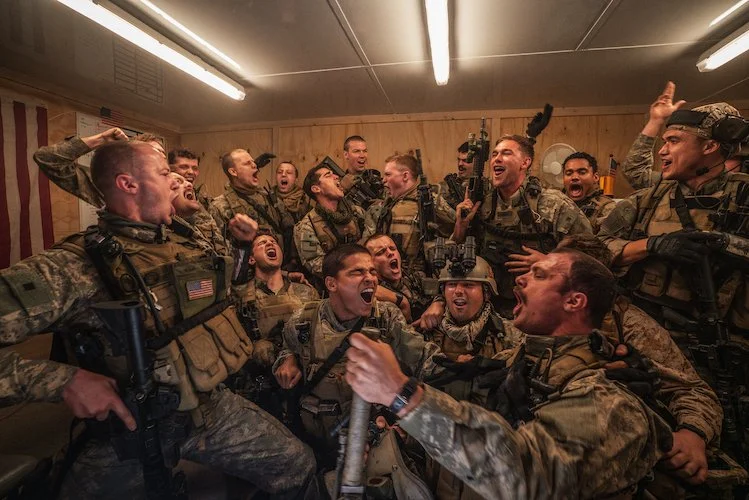
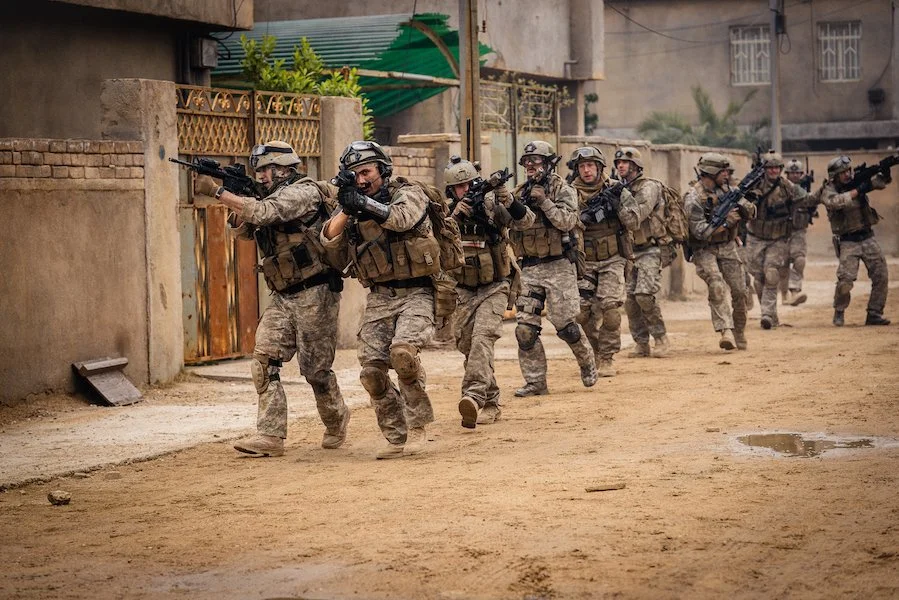
Up to this point the general consensus has been that Steven Spielberg’s Saving Private Ryan, or at least the opening 20 minutes, is the best realisation of the agony of war on screen to date but – hot take – I would dare say Warfare does it better, faster and unrelentingly. The trick of Warfare is how Garland and Mendoza are trenchant in just how mundane war can be, so when the calm is ripped by the storm we really feel it. The dust, the roar of jets in a “show of force”, the barrage of gunfire, the shrieks of the wounded, the cracked lips and viscera, the anonymity of it all and the simplicity of the storytelling make Warfare almost palpable in its confidence this is all nonsense. The mission is fuzzy at best, the reasons the SEALs are there even more so, average Iraqis are given no voice – as there weren’t in reality – and once the fighting starts the trauma starts at the same time. Barker’s use of sound, or silence, is masterful and focuses the terror and confusion to a razor’s edge, captured by Thompson’s doc-style images that reveal horror upon horror as the smoke clears. There are no heroics in Warfare, though certain types are going to read band of brothers valour in it anyway – it’s baked into the DNA of war films – and it wisely ends without an ending. Because there never is. The film doesn’t say anything new about the futility of war but it’s not exactly a message that’s gotten old. We’re still not listening.