
Producer Genki Kawamura steps behind the camera to adapt a puzzle game for maximum, efficient effect. he should try ‘Wordle’ next.
Exit 8
Director: Genki Kawamura • Writers: Genki Kawamura, Kentaro Hirase, based on the game by Kotake Create
Starring: Kazunari Ninomiya, Yamato Kochi, Naru Asanuma, Kotone Hanase, Nana Komatsu
Japan • 1hr 35mins
Opens Hong Kong September 4 • IIA
Grade: B+
What does it say about the collective Japanese psyche, I wonder, when the “horrors” of modern life are, first, a young woman getting all up in a salaryman’s bizniz; second, a flustered salaryman (a different one) openly speaking his mind in public; third, the knee-jerk reaction to blindly follow instructions; and finally the spectre of a tsunami. The last one makes total sense; 3.11 is understandably Japan’s 9/11. The others, though, are curious and disturbing, and one is entirely in line with the world’s apparent swing to the right of late. All make for compelling plot points, however, and in Genki Kawamura’s Exit 8 | 8番出口, become part of a surprisingly engaging psycho-horror that wraps things up just shy of seriously wearing out its welcome and demonstrates how to make the most of a single set and, probably, a teeny-weeny budget.
An asthmatic temp worker, identified only as The Lost Man (Arashi’s Kazunari Ninomiya, Gantz, Letters from Iwo Jima) is riding the subway, blithely ignoring the fuss of a dude shrieking at a woman for not hushing her shrieking infant. He’s listening to “Bolero”; no one else is paying them any mind either. He gets off the train and takes a call from his ex-girlfriend (Nana Komatsu, Threads - Our Tapestry of Love) who tells him she’s pregnant and at a hospital right fucking now, and after he fumbles about like a fool (don’t start on the Klutzy Dude Who Sucks At Life thing) he finds he can’t get out of the subway station. He’s looking for Exit 8, but gets caught in a psychotic repeating loop, along with The Walking Man (Yamato Kochi, wonderfully creepy in NPC mode), The Schoolgirl (Kotone Hanase) and The Child (Naru Asanuma). There’s a game here, one that sends The Lost Man out the door at the end (uh… spoiler?) a different man. One that sucks at life less.
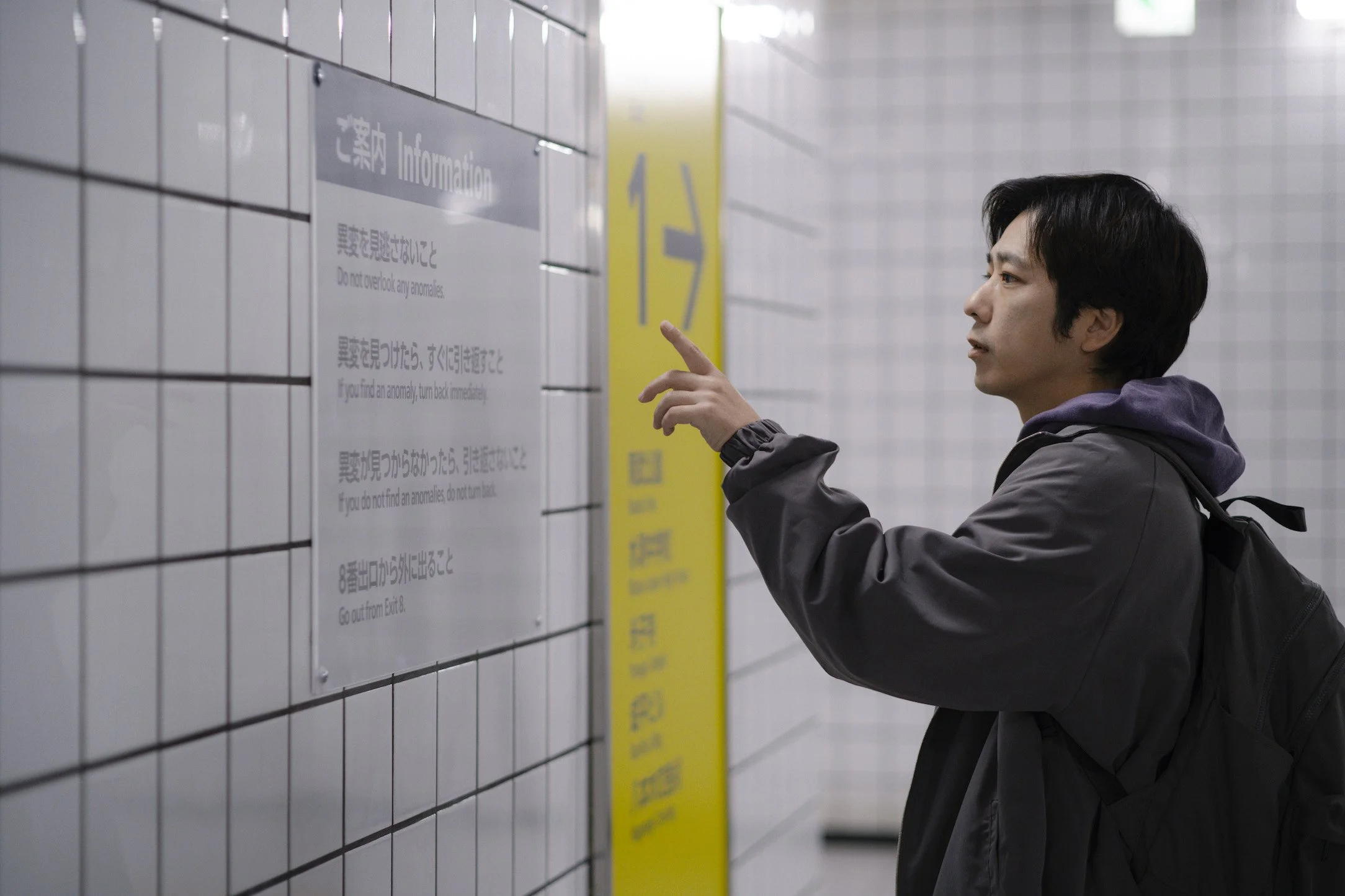
Hai, hai, hai… still stuck
Exit 8 had a splashy Cannes premiere last May and beyond all logic, the film based on the first person 3D walker adventure game The Exit 8 could be one of the best game adaptations to come down the pipe in a while. I say “could be” because I’ve never played this game. But despite the spot-the-difference puzzle-based restraint of the game (read: lack of story), Kawamura and co-writer Kentaro Hirase have managed to find a way to make that puzzle about guilt, redemption, personal convictions and embracing change and wrap it all in a precise and almost perfectly edited (by Sakura Seya) narrative. The eerie liminal space of a rote Tokyo subway corridor – we’ve all seen this kind of unusually empty place and probably commented on how freaky it looks without people in it – is the primary location for The Lost Man’s transition. What the transition is becomes clearer as the so-called story goes on, but his conundrum is also dotted with social anxieties recognisable in Japan.
When The Lost Man figures out he’s trapped in the station he reads the board and does as it says: Look for the anomalies on his route, continue on if all looks okay and start again if they don’t. Simple. He does as told, and we study the hallway ads and door placements too, making every time he gets busted back to Exit 0 gutting. One of Exit 8’s best running gags is the inevitable meltdown the players have after one failure too many.


Maybe none of this should be that much of a surprise given that Kawamura is also a producer with a ton of heavy hitter credits to his name: Confessions, Villain, Monster, Suzume and Your Name as just a few. What is surprising is that this video game spin is his first directing effort after the conventional family drama A Hundred Flowers. Hey, clearly Kawamura likes to mix it up. But not too much. After a suitably immersive extended first person POV opening shot the clear references to Stanley Kubrick’s The Shining and Vincenzo Natali’s Cube come on thick, but blessedly never feel like a rip-off. Along with Seya, art director Ryo Sugimoto does an amazing job of making the (mostly) single set contribute to the storytelling and to The Lost Man’s rising frazzlement that threatens to tip over into straight-up hysteria. With the exception of some OTT collapsing early on (dude, you’re asthmatic, not being consumed by flesh eating disease, stand yo’ ass up) Ninomiya is convincing as an unremarkable man cycling through fear, paranoia and acceptance in the subway and in his life. The anomalies he finds and the paths he crosses do hold symbolic significance and the closing frames serve as a satisfying reset without forcing an egregious, explanatory scene. Believe me, I was waiting for it. Knowing when to pack it in earns Exit 8 a B at the least.