
Hard Pass
Are horror tropes rooted in dumb people getting tired or am i just getting old?
Passenger
Director: André Øvredal • Writers: Zachary Donohue, TW Burgess
Starring: Lou Llobell, Jacob Scipio, Melissa Leo, Joseph Lopez
USA • 1hr 35mins
Opens Hong Kong May 21 • IIB
Grade: C-
Anyone who’s ever been on a road trip will instantly recognise the simultaneously exciting and harrowing nature of this kind of travel. For all the hidden gems and hilarious one-off encounters, there’s the stress of hitting a target reservation, the nerve-shredding frustration of running low on fuel with no service station in sight, or worse, running out of daylight and being forced to deal with the mesmerising nature of night driving (those lines). That’s prime horror material right there, and it’s been mined effectively, in varying iterations, in The Hitcher, Wolf Creek, Jeepers Creepers, and even Steven Spielberg’s first film, Duel. You’d think Norwegian director André Øvredal would be the right person to make something of this. He’s squeezed a lot from a little in the past: his 2010 breakout Trollhunter wisely played Norse mythology straight in its found footage mock doc, and the eerie horror-thrillers The Autopsy of Jane Doe and The Last Voyage of the Demeter exploited familiar clichés – from, essentially, CSI and Dracula – for creative, alternative POV chills.
So in his latest, Passenger, when a young, mostly professional Brooklyn couple (is Brooklyn still code for edgy and cool?) abandons their desk jobs for a life living out of a tricked-out, totally wired van (a Mercedes van, for the record) and find themselves face-to-face with a demonic entity, expectations are justifiably high for something juicily off-centre. Unfortunately Øvredal is let down by (mostly) newcomers Zachary Donohue and TW Burgess’s script, which feels like a second AI draft version rather than a fully considered concept. Every trope, convention and archetype you could possibly scrape from imagine in a post-A24 horror film is here, but none is subverted or leaned into with unfettered glee enough to raise Passenger above eye-rolling foolery. This is not The Hitcher.
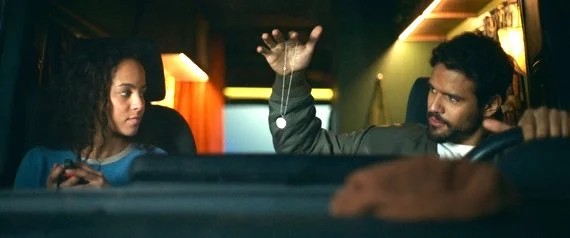
No one’s windowless van is that nice
Passenger begins with a couple of dudes driving… somewhere late at night. They’re on a dark AF back road, and when one stops for a pee break – and of course going about 500 metres into the bush instead of just hitting the nearest tree on the shoulder – the other mysteriously vanishes. Naturally he’s mauled by an unseen force and his peeing buddy takes off. Elsewhere, Maddie (an anonymous Lou Llobell, Apple TV’s Foundation), who I think is an interior designer, and her finance bro boyfriend Tyler (a bland Jacob Scipio, Bad Boys: Ride or Die) quit their jobs, pack up their exposed brick and floor-to-ceiling window Brooklyn flat and hit the road for a Nomadland-style life on the Interstates, in 24-hour gym parking lots and in caravan parks. The two events merge when Tyler and Maddie stop at a crash scene involving the pee break dudes, call an ambulance and unknowingly pick up The Passenger (Joseph Lopez). That’s at least according to squirrelly van lifer Diana (Melissa Leo) who warns them about scratches, drving at night, stopping to help strangers and ultimately tips them off about a force of evil. Blah blah blah, St Christopher and patron saint of travellers, blah blah blah, possessed, blah blah blah.
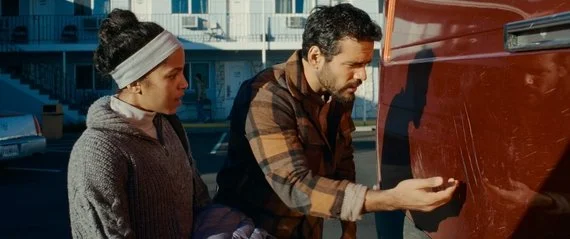
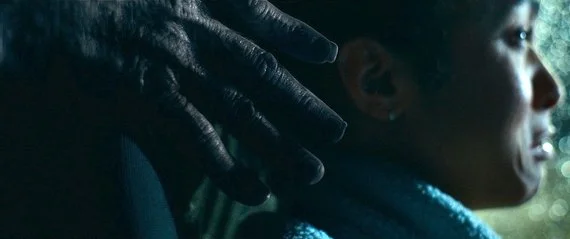
Passsenger’s biggest hurdles are its infuriatingly dumb characters that do dumb things (see: peeing in the woods) and half-baked story. Is it really so hard to make sure you find a motel before dark? Why would anyone let their partner go out into a barren carpark in the dark, alone? Who exactly is The Passenger? Does he have an axe to grind? Why are Tyler and Maddie even a couple, particularly when he’s, as a rule, so dismissive of her? I get it: rooting for or against certain characters is in horror DNA, but that doesn’t mean everyone has to be a moron. In one scene, Tyler suggests splitting up (again, of course) to complete some tasks which Maddie puts the kibosh on and says they’re staying together. When logic becomes a high point of the plot, you’re in trouble.
Somewhere buried deep down there’s an interesting story about younger people becoming so frustrated with the “American dream” as it now exists they’d willingly drop out and disengage from the structures they’ve been told are life’s ideal options, and of course encounter a demon along the way. That said, the central couple agrees that a nice home in a gated community (ha, like these two would be allowed in a gated community) looks pretty good at the end of their adventure. Capitalist conformity, FTW! But Øvredal is more fixated on visuals, many of which are solid (like that parking lot scene, and you’ll never change a tire the same way ever again) and Donohue and Burgess have no idea (or their ChatGPT prompts were weak) how to weave those themes into the narrative – or any themes really. In the end the only message that comes through would rival the Southeast Asian Hellhole™ genre’s: Stay home, and if you do go out, fuck that guy.