
All Squawk
Is Grief horror a thing? Grief horror is a thing.
The Thing with FEathers
Director: Dylan Southern • Writer: Dylan Southern
Starring: Benedict Cumberbatch, David Thewlis
UK • 1hr 38mins
Opens Hong Kong January 15 • IIB
Grade: B-
There is a very fine line between grieving and being irresponsibly self-involved, and first time feature director Dylan Southern and Benedict Cumberbatch ride that line to within an inch of its life in The Thing with Feathers, the film version of Max Porter’s slight 2016 novel, Grief is the Thing with Feathers. Not only do they ride that line in terms of empathy, Southern flirts with grief horror (think Hereditary, The Babadook) too, which has otherwise been called “elevated horror” and we all know how that’s been done to, erm, death (sorry).
Now, far be it from me to tell someone – real or fictional – how long, how hard, how period they should mourn the death of a friend, spouse, family member, pet or favourite rock star for that matter (I’m still not over Prince) but part of the nuance in Feathers is confronting that urge in most of us to throw our hands up and say, “Enough, already!” to someone mired in the grieving process. Most of us will let things slide if newly widowed Jenny goes home right after work every night for a protracted period of time. If Long avoids parties for a bit right after a brother’s death, so be it. But if Jenny and Long are neglecting anyone, and worst of all leaving children to suffer on their own, we start to lose patience – and sympthathy. And if you try and argue you would never! you’re deluding yourself. Right or wrong it’s what we do.
Woe is me
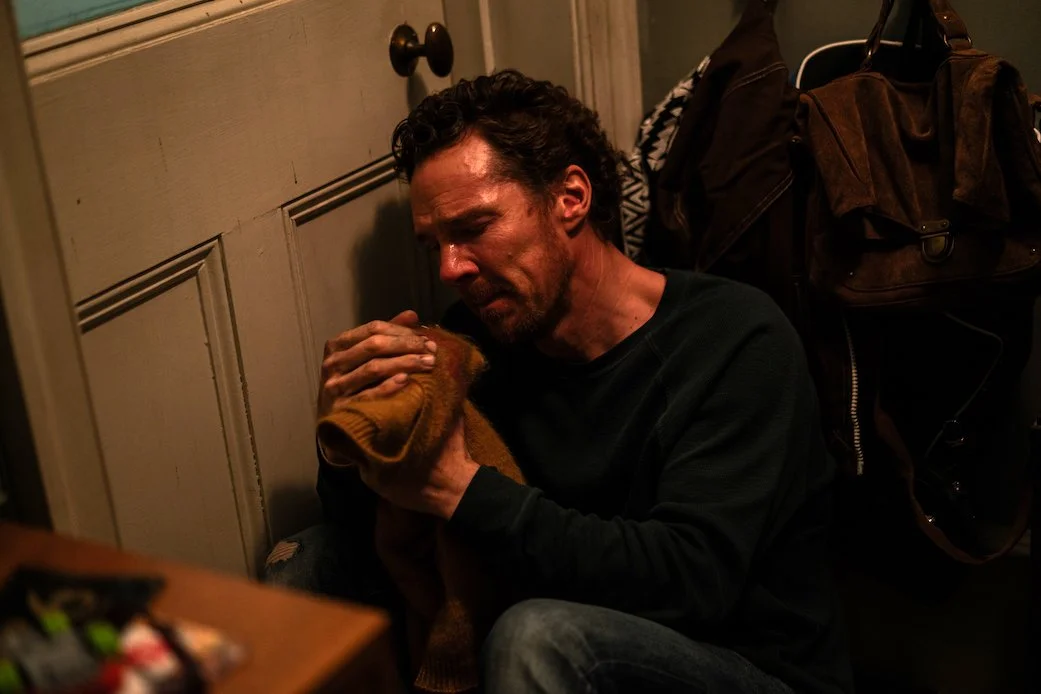
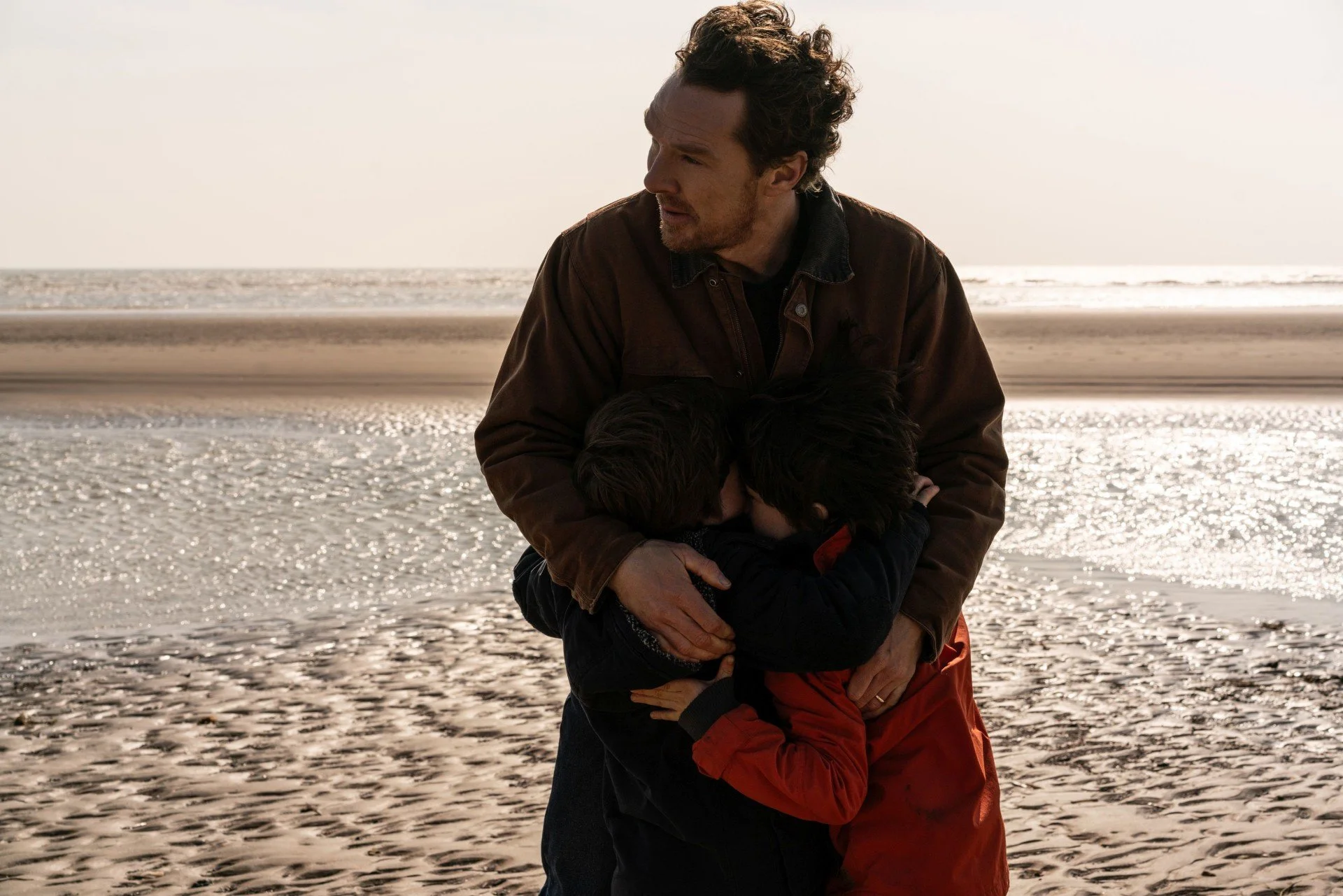
Broken into four chapters – “Dad,” “Boys,” “Crow” and “Demon” – that’s exactly the position Dad (Cumberbatch) finds himself in in The Thing with Feathers. Dad’s demonstrable grieving process starts just as he’s leaving his wife’s funeral service after her sudden (seemingly accidental) death. He’s with his young sons, identified only as Boys (Richard and Henry Boxall), the same way their deceased mother and Dad’s dead wife is just Mum (Claire Cartwright) and it becomes clear he’s a complete mess. They’re at the family home, at times lit with soft sunlight that shows off dust particles, at other times dark and sinister like the sorrowful abyss it becomes. That’s largely thanks to Dad’s crushing grief being made manifest by Crow (Eric Lampaert in body and David Thewlis in voice), who quickly shows up as Dad tries and fails to care for his boys, or care much about his work as a graphic novel writer. We get each’s perspective on Dad’s sorrow, starting with him and Cumberbatch’s best performance in years. Whatever Feathers’ shortcomings, Cumberbatch certainly commits to the role of the walking raw nerve who seems to have at least temporarily run out of fucks to give. The Boys’ entry packs the most emotional punch (though not for them), Crow’s is the most sardonic and occasionally grimly funny in his intolerance of Dad’s pain and “white suburban jazz.” All of them ultimately lead to some semblance of healing.
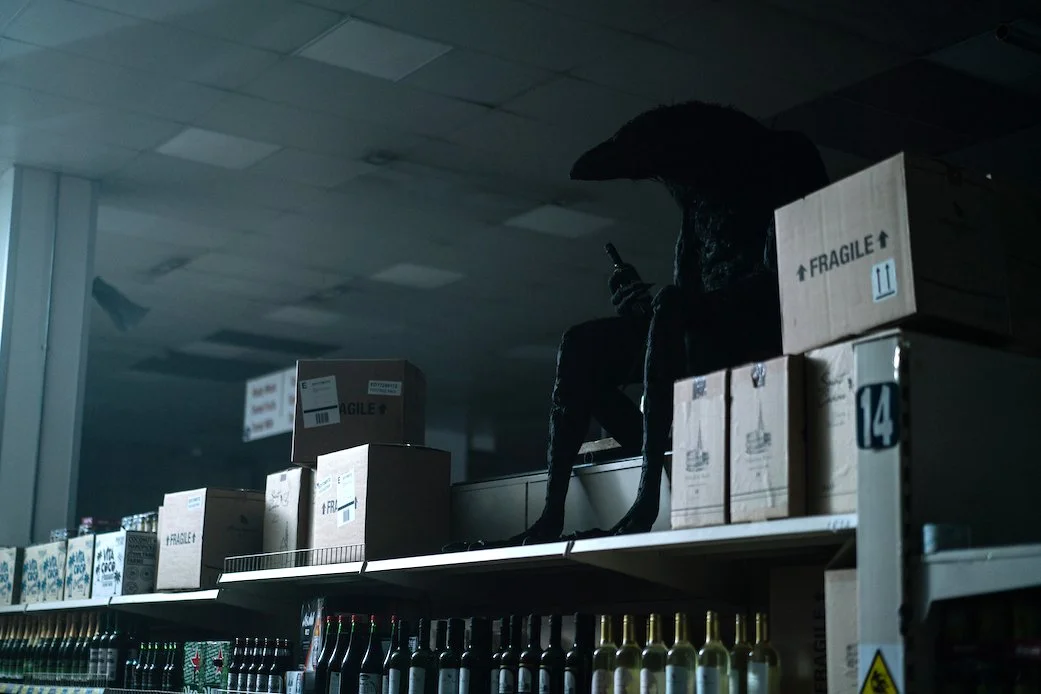
Porter’s source material was a literary experiment of sorts, written in a mash-up of prose, poetry and essays, with a shitload of references to writers Ted Hughes, Sylvia Plath and Emily Dickinson; there was a stage adaption in 2018 starring Cillian Murphy. So it comes as no surprise that Southern would mix it up by leaning hard into horror, and Crow is indeed a striking creature. Thewlis, reaching back to his Naked days, helps make him a vivid product of Dad’s mental state, but he’s striking – not terrifying. The horror elements are there for the picking but Southern comes from music video (for Franz Ferdinand, Arctic Monkeys and Björk among others) and music doc background (Meet Me in the Bathroom), and is unable to exploit horror convention consistently enough to give Feathers an identity. It doesn’t help that the singular focus on Dad has the barest foundation to stand on. Mum is seen in flashes and half frames and so we never get a grip on why her absense is so intense – other than perhaps she did the cooking, cleaning and child-rearing like a good 1950s housewife? Boys are there purely to be annoying, interrupting Dad with their own grief (rude!). Without any idea of why Dad’s grief is rooted where it is, The Thing with Feathers just runs around like a chicken with its head cut off.