
Feng Xiaogang continues his up and down and up and down pattern with a women’s prison drama with hardly any prison.
We Girls
Director: Feng Xiaogang • Writer: Xia Longlong
Starring: Zhao Liying, Lan Xia, Chuai Ni, Wang Ju, Cheng Xiao, Wang Xiaoyu, Qian Yi
China • 2hrs 4mins
Opens Hong Kong May 29 • IIB
Grade: C+
We Girls | 向陽·花 is hilarious. Not a so-bad-it’s-good kind of hilarious, nor is it a movie that’s so unbearably sentimental it just elicits laughter instead of empathy or the targeted tears. No, in We Girls every “hard hitting” moment, or whatever is supposed to pass for tension, heart-warming humanity or even comedy – no surprise given that director Feng Xiaogang cut his teeth in comedy (Big Shot’s Funeral) – is almost completely undone by the story, usually in a third act revelation that torpedoes the emotional payoff and simple logic that came before. On the surface We Girls is about a young, deaf-mute inmate who makes friends with a single mother on the inside of one of China’s super-clean medium-security, pro-art therapy prisons, and becomes her bestie, her advocate and her ally on the outside. What it’s really about is China’s stellar incarceration and rehabilitation system, its dedicated, sympathetic prison guards and how they’re trying to build a system committed to fighting the root causes of women’s crime and preventing it to begin with. But this ain’t Orange is the New Black in China. If Feng and writer Xia Longlong made any comments about systemic failures as relates to ex-cons, cycles of poverty, sexism, domestic violence or discrimination against the disabled they buried them beneath a warm and fuzzy portrait of the corrections infrastructure and a bootstraps feminism that prioritises sisterhood over action. This is certainly no I Am Not Madame Bovary, one of the hot-and-cold running Feng’s hotter items. Make sure you stick around for the bananas post-credit stinger. Which is 10 minutes (!) long. Just… trust me.
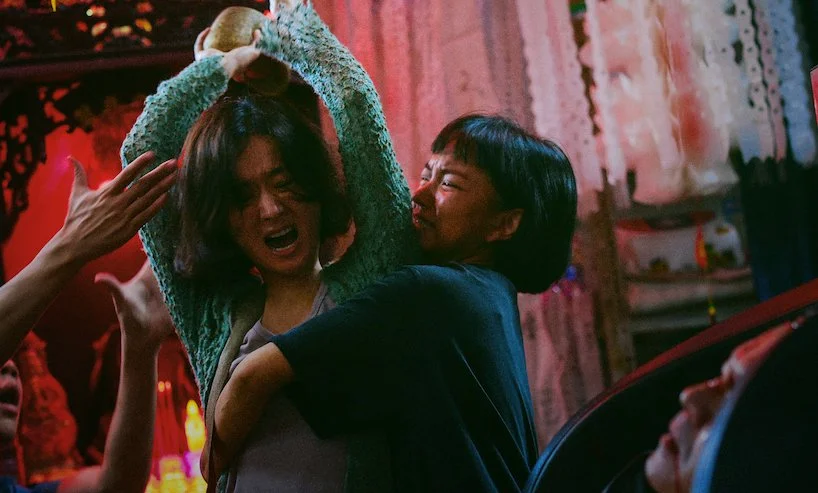
We Girls begins with first girl Gao Yuexiang, AKA White Fox (Zhao Liying, Article 20, Peter Chan’s phantom She’s Got No Name) during intake at an unnamed prison to start a two-year stint for, essentially, stripping online. But she had a good reason! She was trying to make enough money to buy her deaf daughter a hearing implant. This is why she knows sign language, and also why she’s assigned to show second girl, fellow newcomer Mao Ah (Lan Xia), a deaf-mute Oliver Twist-type pickpocket, the ropes. In a not at all Caged Heat callback, Gao and another inmate immediately get into a fight – there’s a lot of face-mashing and hair-pulling – on which blustery cell boss and third girl Hu Ping (Wang Ju) snitches. No stitches, though, because really. Hu’s just overcompensating for her crushing insecurity. The guard who answers the call is Deng Hong (Chuai Ni), who’s just there to help. To reform these women, not to punish them. So much so she’s constantly lending Gao and Mao a coupla’ hundred RMB all the time and inviting them for dinner. Needless to say after a cathartic prison talent show Gao and Mao are paroled, and together overcome the endless stream of shit that flows their way, from near-rapists to lying elites and the ghosts of the past who won’t give them a chance to get their lives back in order – and an orphanage that won’t give Gao back her daughter (ummm, unemployed, unhoused ex-con here). They finally do overcome with the help of another of Deng’s reform pilot programme subjects, fourth girl Guo Aimei (Cheng Xiao) – no idea why she’s here – and Mao finally gets a reckoning with her personal Fagin, Old Daddy (Qian Yi, The Invisible Guest). And if you think that sounds like there’s not a lot of prison antics, you’re right. They’re sprung in Act One.
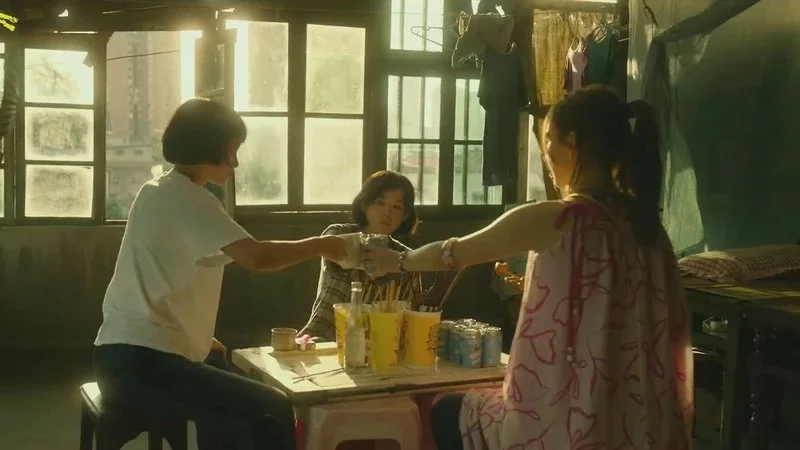

We know what we’re getting when we sit down to an Issue Movie like We Girls, and the film would be welcome to deliver all the propaganda it wants to if it were halfway decent, with a cohesive narrative; something enlightening or, at a minimum, entertaining (Wolf Warrior). But it’s not. Feng and Xia dance around the topics they tease at examining and play at deep thinking, then pull back for melodramatics worthy of a K-drama, piling on trauma upon trauma and, in fact, punishing the characters needlessly. Perhaps that could have formed the foundation of a character piece, but despite Zhao’s best efforts, Gao remains intensely unlikeable for most of the film, without ever providing a reason to at least empathise with her. Mao is a thief, and at one point while they brainstorm ways to make some cash Gao pressures her into robbing people on a boardwalk. This despite Mao wanting a clean break. She says she’s kidding at Mao’s distress but it’s the kind of sloppy writing that prevents Zhao from creating a character that wins us over. Lan fares better with the more tragic Mao, managing to look young and vulnerable and old and jaded at the same time, helped along by the striking angles of her face and a lived-in, modern portrayal of someone who’s hard of hearing (admittedly Zhao helps too). Midi Z DOP Florian Zinke’s images feel ripped from TV, and aren’t nearly as expressive as anything in Nina Wu or The Unseen Sister. But the real kick in the teeth comes when it turns out Gao and Mao’s bond is worthless, founded on a house of cards, which in itself would be fodder for more drama but as it stands is brushed aside like it’s no big deal. It is a big deal, and it renders the trials and tribulations they endured – and any emotional investment viewers may have made – utterly meaningless. Why Feng and Xia decided to pull the rug out from under us is anyone’s guess, but it’s infuriating. And it’s a cheap shot. Go find 1988’s Woman Prison | 女子監獄 instead.