
Daddy’s Issues
Chung suet-ying grows up and Nick Cheung dials it down and what do you know? Engaging drama.
Good Trip
Directors: Norris Wong, Wong Hoi • Writers: Norris Wong, Wong Hoi
Starring: Chung Suet-ying, Nick Cheung, Philip Keung
Hong Kong • 1hr 38mins
Opens Hong Kong October 15 • IIA
Grade: B
Good Trip | 我阿爹想旅行 starts with an homage to Hong Kong’s golden age of cinema, as so much of the city’s backwards looking films do these days. Retired actor Mok Chun-keung (Nick Cheung Ka-fai) is watching an old wuxia adventure on TV from his hospital bed between cancer treatments. It’s a typical 1960s or ’70s fantasy, all wire work, super-long waggling eyebrows on the sifu and random zooms. Of course, we don’t realise that’s what it is until the camera pulls back and we see Mok in the bed. It’s at this point the real world exerts itself in the form of Mok’s daughter Shan (Chung Suet-ying, who it turns out has some thoughts these days on some media writers and preach, girl), a budding production designer, drops in to check on the old man. It’s clear from their familiar by slightly icy dynamic they have a complicated relationship, and she’s there out of duty as much as affection. Quite randomly Mok decides he wants to run some of his own errands and busts himself out of the ward, and winds up dragging Shan on a road trip to Macau and Okinawa, a trip that ultimately becomes Mok’s farewell tour.
Co-directors and co-writers Norris Wong Yee-lam (My Prince Edward, The Lyricist Wannabe) and Wong Hoi (Let it Ghost) have been working together for most of both their careers, and their familiarity with each other shows in Good Trip, a comfortable if not terribly challenging family dramedy that edges ever so slightly into the mainstream, far more so than any of their past films. As down the middle as Edward’s content was it also had a melancholy to it that’s unconventional for Hong Kong marriage stories, and Wannabe really zeroed in on the minutiae of Cantonese lyric construction – not really for anyone who just want to sing along. Good Trip flirts more overtly with the accessibility Hoi injected into Norris’s script for Ghost. Most women have a father, most will lose one. All will be exasperated by them at some point.

It must be a road trip for that much green
Despite having a ton of work to do on set, for a film by an exacting and humourless director (the very not stern and humourless Jack Ng Wai-lun in a cameo) Shan makes excuses and gets her assistants to cover for her as she accompanies her father to, first, Macau, where he insists on collecting a debt from casino worker Uncle Hong (Philip Keung Ho-man) – and maybe to indulge his unhealthy taste for gambling one last time. After that it’s off to Okinawa to reunite? Atone? Beg forgiveness? from Shan’s mother and his estranged wife Fong (Yoyo Mung Ka-wai), who’s been living in Japan since her own father got sick. The family eventually heads back to Hong Kong.
There’s not much more to Good Trip than that. It’s not a film that relies on narrative and plot to tell its story. Like Wong and Wong’s other films it’s simply about the people who inhabit them and how they relate to each other – be they boring, thrilling, messy, unremarkable, selfish, selfless or any combination thereof – how they deal with mortality and how they reconcile loss. And because of that it’s a movie that lives or dies by its performances. In their attempt to get into the mainstream Wong and Wong could have opted to go big like so much drama in Hong Kong can. Instead they go low-key, partly because Chung, when she’s not mugging badly (looking at you, The Snowball on a Sunny Day), brings her usual low-simmer energy to Shan, which makes for a nice complement to Cheung’s more Cheung-y boisterousness. I’ll cop to not being a huge fan of Chung to this point, her lightly surly Gen Y, Z, alpha, beta, gamma or whatever the fuck everyone has labelled it, aloofness not really leaving an impression, but she shows off a heretofore unseen maturity that works here (and even more in the forthcoming We Are Born Good) that shades the character without being flashy. Her crankiness is justified.
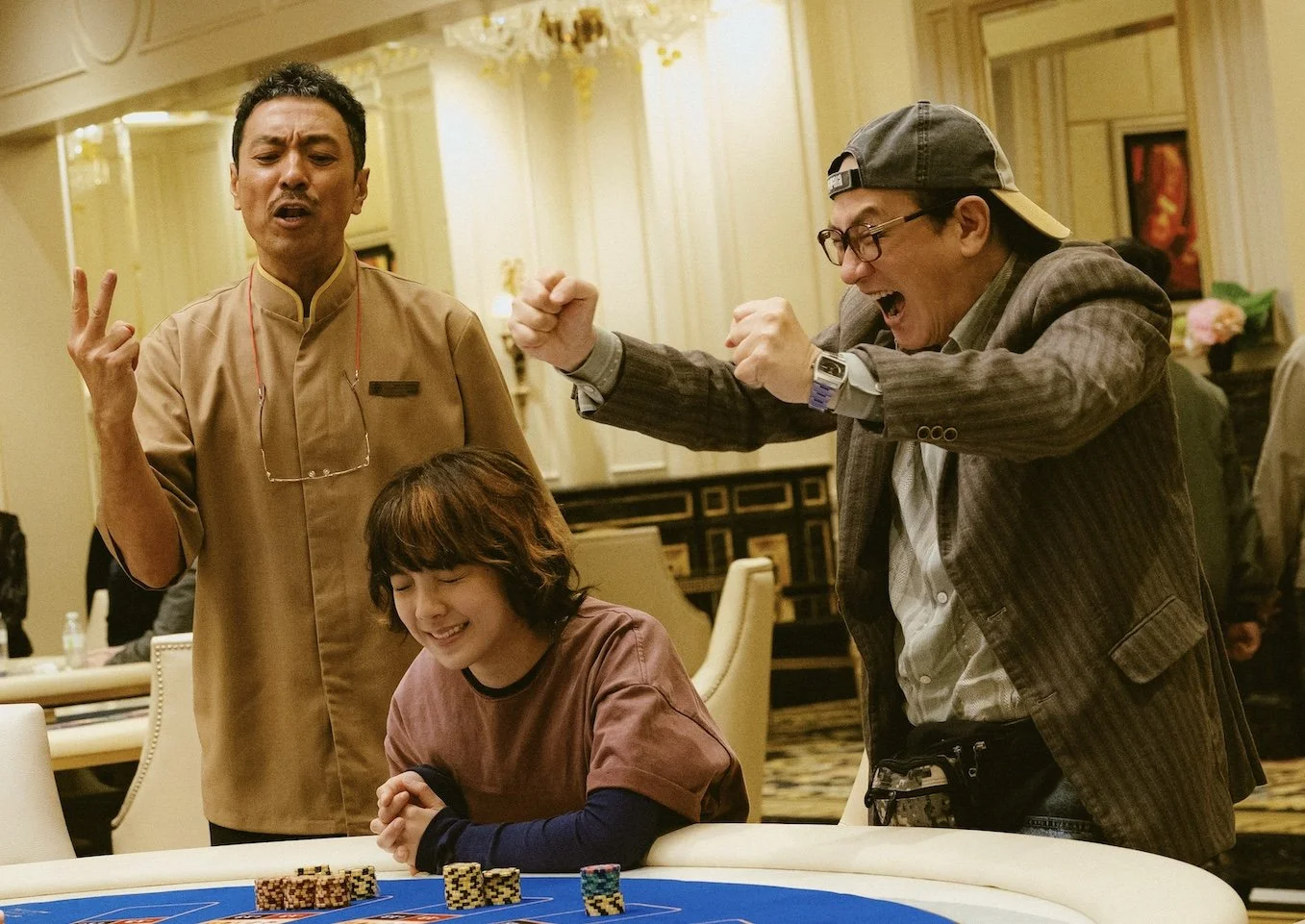
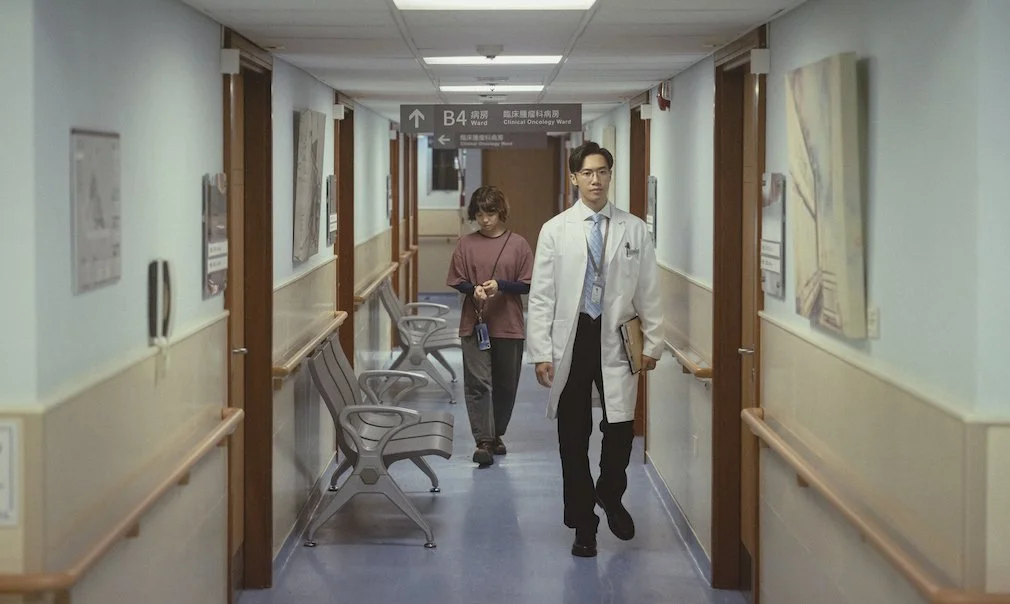
It’s in the quieter moments, when Shan gets a rare glimpse at who her father really is, or can be, that the film comes together thematically. Mok is at the end of a long performance, and Shan finally gets to see him outside of a role. Is it too little too late to repair their relationship? Mok certainly doesn’t think so.
Wong and Wong have also gone on record stating Good Trip is sort of a love letter to Hong Kong movies as well, and there are lots of cameos from familiar faces in the industry, past and present, to make sure we know it. Ng is one. Cheung is in on a meta joke about his many, many period TVB dramas, and a pile of current action stars (and a MIRROR) show up in the wuxia film and the road trippers’ God of Gamblers coded Macau excursion. But it’s still really about Mok and Shan, and her dawning realisation this may be the end of the road for her and her dad. It’s also Cheung’s movie, a nice reminder that he can be funny and moving when he puts his mind to it. Looking at you, Wolf Hiding and Go For Broke. It’s not Wong and Wong’s most scintillating collaboration, that’s still My Prince Edward, but there’s a decidedly unsappy, bittersweet ode to daughters and dads at the core that makes Good Trip not a half bad one.