
A Tale as Old as Time
Talk about art imitating life…
Nuremberg
Director: James Vanderbilt • Writer: James Vanderbilt, based on the book by Jack El-Hai
Starring: Russell Crowe, Rami Malek, Michael Shannon, Leo Woodall, Richard E Grant
USA / Hungary • 2hrs 28mins
Opens Hong Kong December 25 • IIA
Grade: B+
James Vanderbilt’s Nuremberg is cut from the same cloth as Annemarie Jacir’s probable Oscar nominee Palestine 36. It’s an old fashioned docudrama that makes no effort to innovate with the form or play with narrative. It’s solid, shot-reverse shot-second shot stuff, with a clear beginning, middle and end. No fucking with time. Because sometimes the material just demands telling a clear, straightforward story and making a clear, straightforward point. It’s the best way to reach the “I don’t get why people are calling Republicans Nazis” or “What are Palestinians so upset about?” crowd. Vanderbilt, a writer (David Fincher’s Zodiac, White House Down, 2022’s Scream) whose only directing credit came 10 years ago with Truth, about a CBS News (these folks have a history) story clusterfuck, deploys this unfussy filmmaking in telling the apparently timeless story of the 1945 Nuremberg Trials, which held Germany’s Nazi High Command to account for war crimes and essentially codified international criminal law as the Nuremberg Principles. The trials have been movied to death, in Stanley Kramer’s 1961 Oscar-winner Judgment at Nuremberg, in Marcel Ophuls’s 1976 doc The Memory of Justice, in TV mini-series Nuremberg starring Alec Baldwin as just a few. This time around Vanderbilt adapts journalist Jack El-Hai’s The Nazi and the Psychiatrist to spin the tale from the POV of the American psychiatrist tasked with determining the Nazis’ fitness to stand trial. It’s not innovative, but Nuremberg is a sturdy courtroom drama with (almost) uniformly strong performances that, shockingly, is terrifyingly relevant and really should be seen.
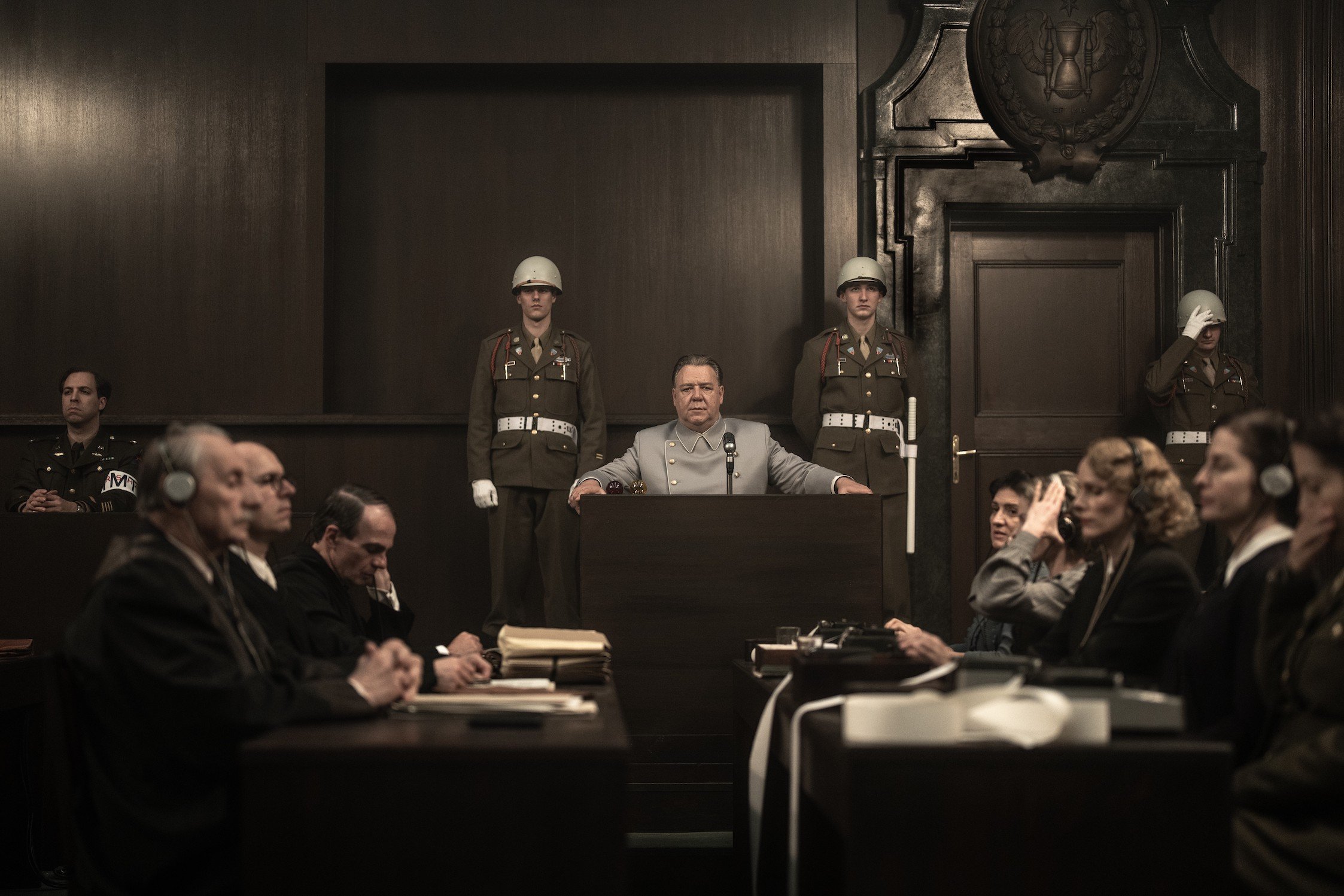
Yet another accent
In May 1945, second-in-command to Adolf Hitler himself, Hermann Göring (Russell Crowe) gets out of a car on an Austrian road and surrenders himself to American militiary police, and is promptly tossed in jail. Halfway across the world in Washington DC – when that kind of meant something – army Colonel Burton Andrus (John Slattery) is recruiting key operators for what many hope will be the world’s first international war crimes tribunal. Prepping for this event in bombed-out Nuremberg are British lawyer David Maxwell-Fyfe (Richard E Grant), some French dude who gets no credit here (in reality it was François de Menthon and Auguste Champetier de Ribes), a Soviet dude who gets no credit (Roman Rudenko) and Justice Robert H Jackson (Michael Shannon), a moderately skilled prosecutor who nonetheless has a devotion to due process – and spanking the Catholic Church for its inaction. Andrus’s other task is to find a psychiatrist that can examine each of the twenty-something defendants and determine their fitness for trial. Chosen for this charming job is military intelligence officer Douglas Kelley (Rami Malek), who drops into the city with visions of book glory in his head. He’s picked up at the train station by bilingual closeted Jew Sergeant Howie Triest (Leo Woodall), not realising Howie will become something of a moral lodestar.
The majority of Nuremberg is focused on Kelley’s uneasy relationship with Göring, who’s every bit as conniving, manipulative, smart and psychopathic as anyone able to orchestrate a Final Solution would be. As time goes on, Kelley finds himself caught amid conflicting loyalties – to his oath as a doctor, to his obligations to the army, and possibly to his friend. Vanderbilt teases an interesting conflict between Kelley and Jackson, both of whom are by-the-book enough to shoot straight with the Nazis (they’re “better than that”), but never dives into the quagmire of Jackson’s willingness to demand Kelley piss on doctor-patient privilege. Does that exist for an intelligece officer? Which comes first? We’ll never know because Vanderbilt doesn’t care.

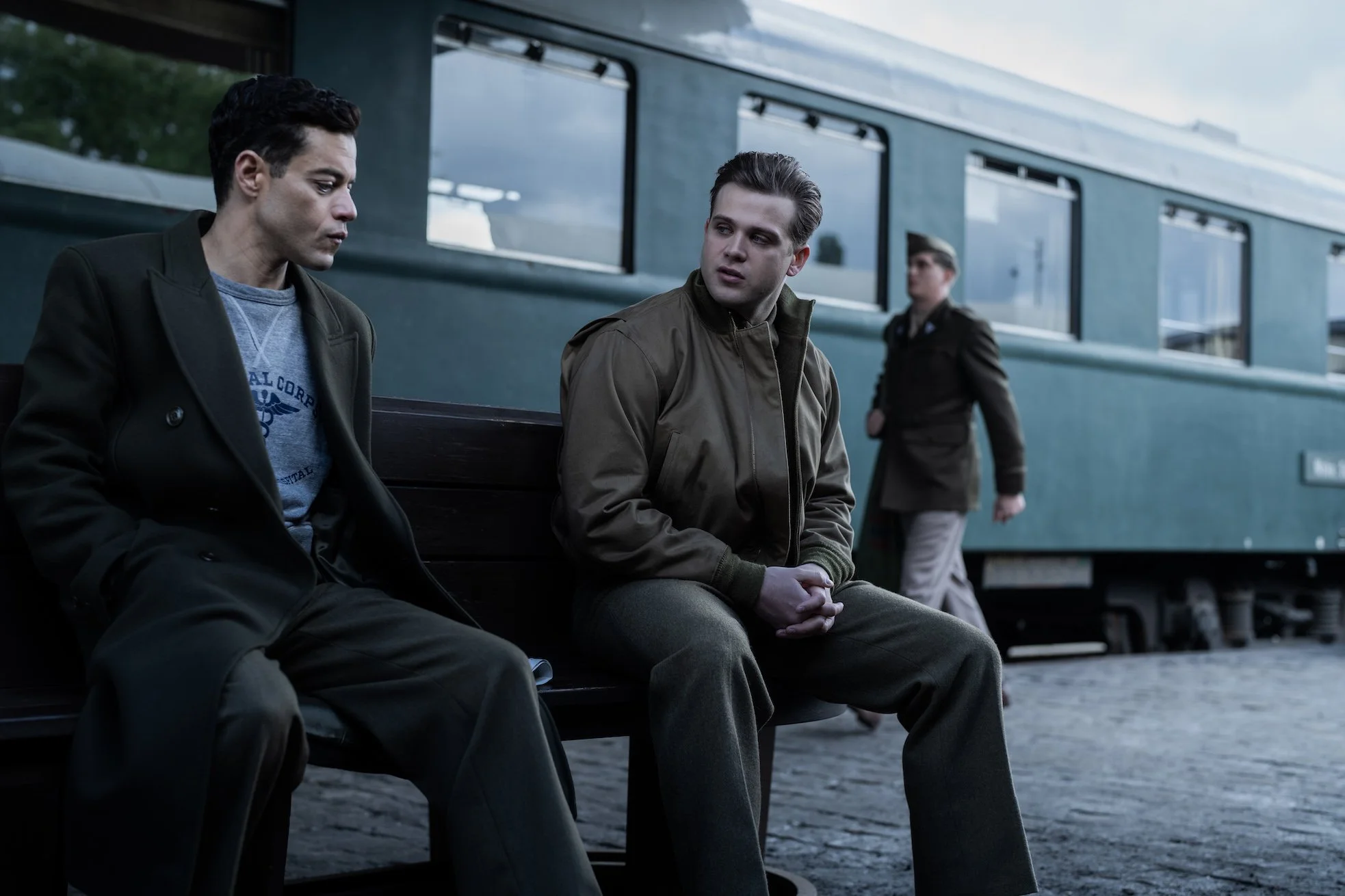
What Vanderbilt cares about is the tension between Kelley and Göring, and crafting a psychological drama along the lines of The Silence of the Lambs or Primal Fear; a verbal cat and mouse between a murderous inmate and the cop/lawyer/doctor trying to figure out what makes them tick. And that fat running time (albeit relatively well paced) hints at the packed nature of the film. It’s not quite clear if we’re meant to be interrogating the roots of fascism, the road to genocide and how we collectively judge the actions of the so-called “normal” people that thought that stuff’s cool, or if we’re meant to be examining the limits of empathy. Are Kelley and Göring friends? Can they be? Göring, of course, wasn’t the only Nazi on trial for murdering millions of Jews, Romani, gays, artists, educators and other dissidents – Rudolf Hess, Robert Ley, Julius Streiche, Erich Raeder, and Karl Dönitz are some of the others who get screen time – but he was among the most prominent, he was unrepentant and he’s at the centre of El-Hai’s book.
He’s also embodied by Crowe, doing his fourth European accent in four years, and juicing Nuremberg with its best moments; it’s these that merge Vanderbilt’s two thematic tracks best. Crowe has always been good at projecting simmering menace, the kind of danger you just know is going to come from nowhere and that skill makes his Göring a kind of erudite thug; a scumbag who hates being outplayed and pouts like a little bitch when he is. Crowe’s subtle shift from smug superiority when he gets the better of Jackson to recognising defeat when Maxwell-Fyfe claps back is a master class in expressive acting, even though it’s barely there. Shame then that Malek can’t quite match Crowe scene-for-scene, only peaking when he marches back to Göring’s cell after seeing Auschwitz and Treblinka film for the first time in court. Malek’s performance tics get in the way the way they did in No Time to Die, and really the way they do in anything other than Mr Robot. Though as a person who’s a prime target to be scooped up by his own government for being too brown maybe he’s the perfect vessel for reminding us why Nuremberg, and Nuremberg, should still be a big deal. We can dunk on the American all we want, but in 2025? They’re not alone.