
Mamoru Hosoda’s gender-swapped spin on the Bard is… gender swapped.
Scarlet
Director: Mamoru Hosoda • Writer: Mamoru Hosoda
Starring [Japanese]: Mana Ashida, Masaki Okada, Yutaka Matsushige, Kotaro Yoshida, Koji Yakusho
Japan • 1hr 51mins
Opens Hong Kong December 11 • IIA
Grade: C+
Short answer? Janai-desu. Which is gutting to say when we’re talking about Mamoru Hosoda putting a Japan-ified spin on Shakesspeare’s Hamlet. In case you’re unfamiliar with Hamlet, Scarlet | 果てしなきスカーレット unfolds in 16th century Denmark, where popular king Amleth – he of a reign marked by peace, diplomacy and equality – is framed for treason and executed by his more authoritarian brother Claudius (Koji Yakusho), who proceeds to marry his wife Gertrude (Yuki Saito), pillage the kingdom and make war with its neighbours. Amleth’s daughter and heir Scarlet (Mana Ashida, Cells at Work) grows into a sword-wielding princess dead set on avenging her father, and almost pulls it off but for a poisoned cup of wine. She winds up in the Otherlands, a kind of parched limbo on the way to heaven or hell, where it seems Claudius and his entire court, has also landed. Her quest for vengeance begins anew.
That is a great set-up for someone like Hosoda, who since departing Studio Ghibli has rattled off a series of fabulously imaginative fantasy epics, among them The Boy and the Beast, the Oscar-nominated Mirai, Belle, which was esentially a sci-fi spin on Beauty and the Beast and now Shakespearean inspiration with Scarlet. Over four years in the making, Scarlet is by far Hosoda’s most ambitious film yet, and its combination of kinda sorta 2D-3D-CGI hybrid visuals frequently flirt with awesomeness; the opening frames with Scarlet drowning in an ocean of hands and bodies, set to a pounding score is an all-timer. But the messages about breaking cycles of blind hatred and violence, while honourable, get bogged down by messy narrative and saccharine sentimentality.
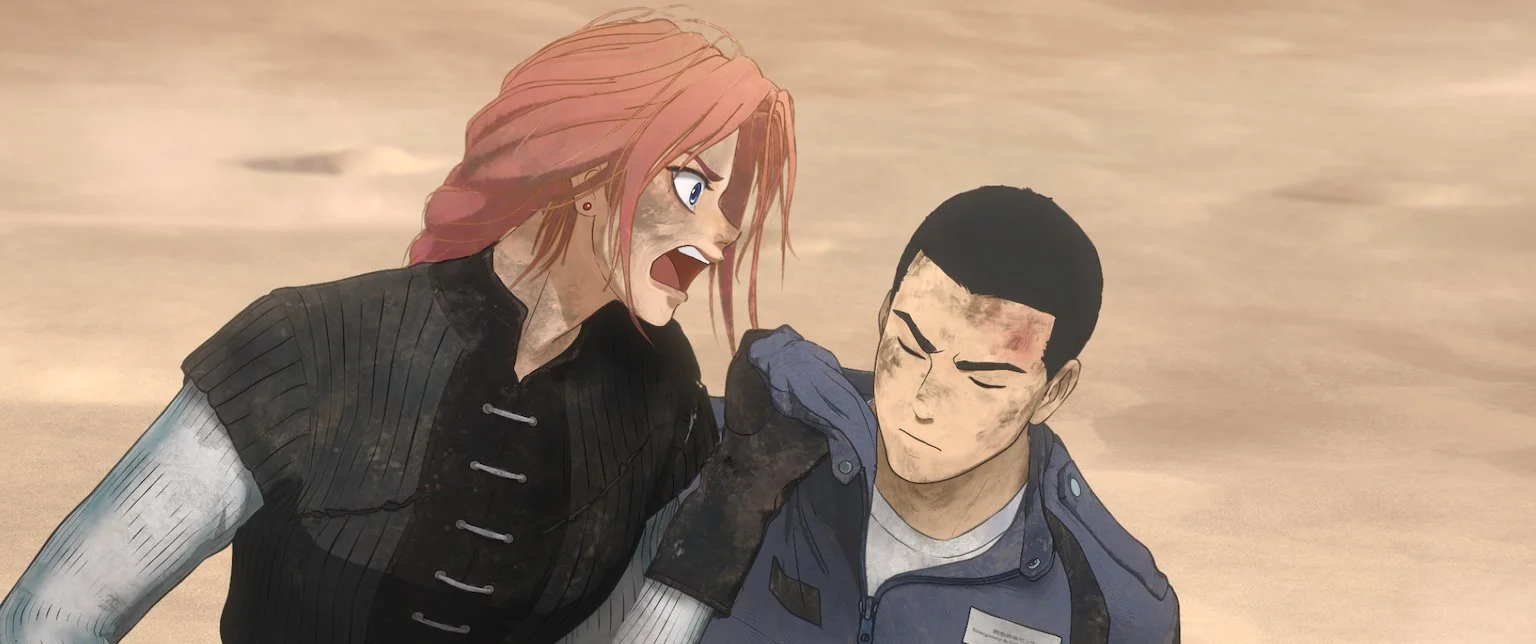
In the Otherlands, Scarlet goes out looking for Claudius, aided by the idealistic 21st century paramedic Hijiri (Masaki Okada, After the Quake), a super do-gooder who’s the type to run into a gang of murderous bandits pleading with them to stop, and then tending their wounds. Scarlet initially can’t abide him (can’t blame her, he’s an idiot) but his fundamental humanity eventually returns Scarlet to hers. Along the way they encounter a group of nomads led by what appears to be Moana, and then a horde of purgatorial souls – the persecuted, the hungry, the unwashed – from around the world and from all times, similarly pissed off with Claudius, who is not only keeping them from the stairway to heaven but represents every tyrant or mad king or corporate zealot or garden variety ruling asshole in history. But Hijiri manages to reach the tender hearts of Cornelius (Yutaka Matsushige, The Solitary Gourmet) and Voltemand (Kotaro Yoshida), and Scarlet starts down a path of forgiveness when she meets a little girl who, if she had a chance to be a princess, would make a world where girls like her didn’t have to die. Oh, and there’s a dragon that fires lightning bolts a people.
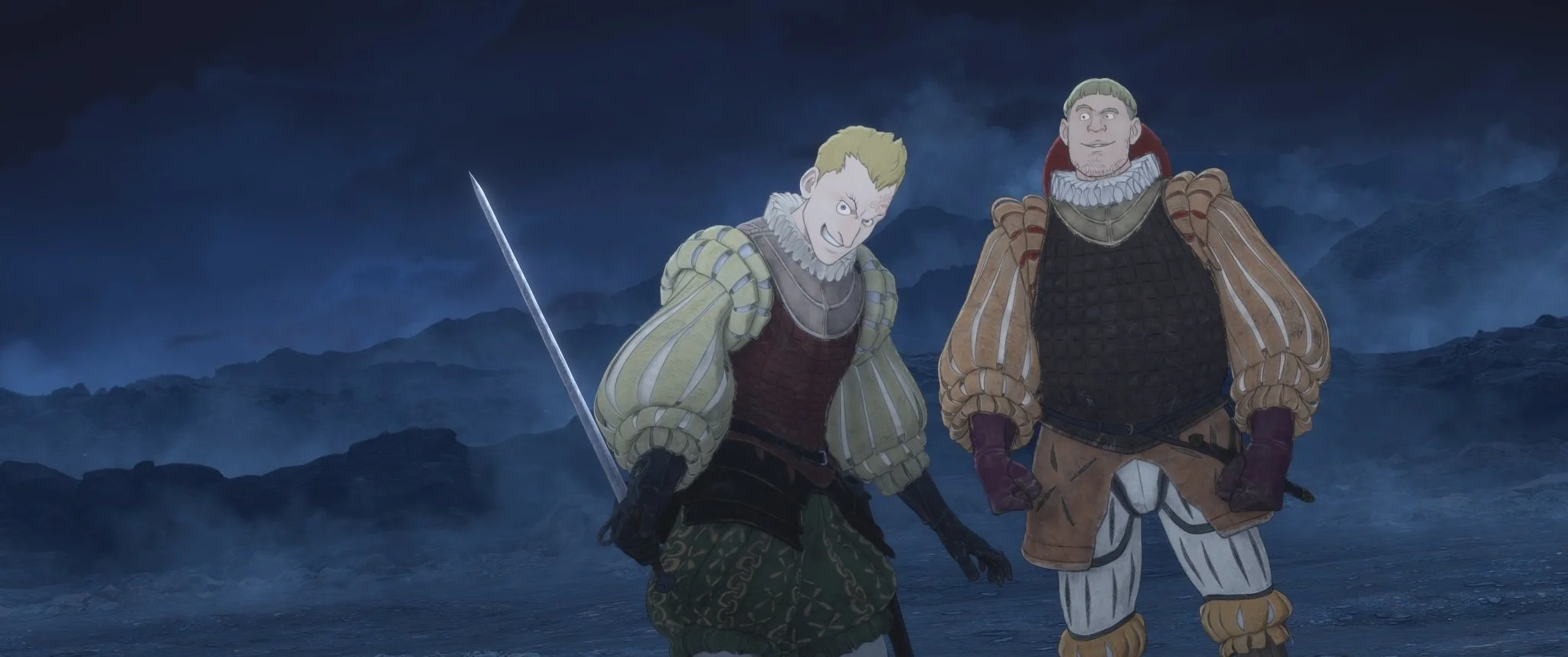
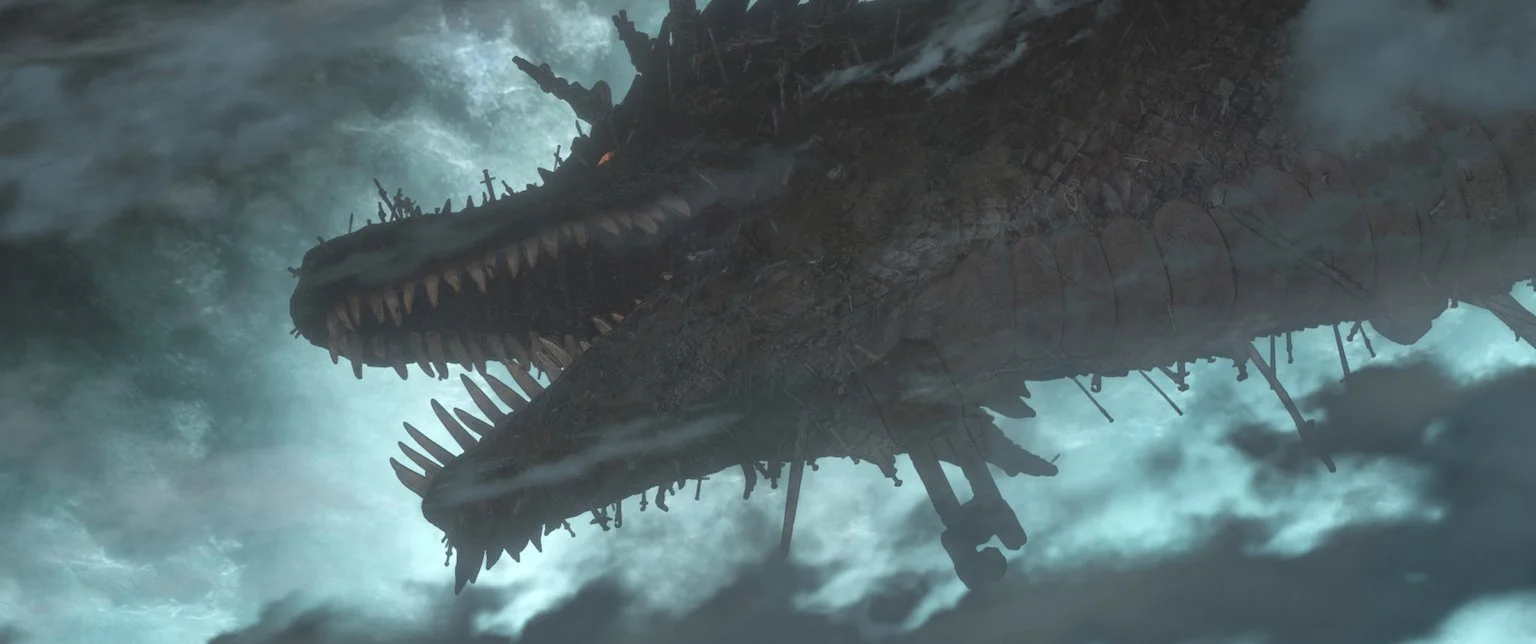
As wildly creative as Hosoda’s script is, its parts never amount to anything new. With little exception, it doesn’t do much to fuse Japanese lore (only one appearance by a ghost?) with Western tragedy, and it never dives into the quandaries it presents. Hijiri is an idiot, but we think he’s an idiot because he’s a poorly written 2D (no pun intended) archetype; a plot mechanism more than a character. Unlike Belle, which played both sides of its source material cards expertly, and Mirai, which put the central character on a personal and relatable road to maturity, Scarlet lurches from Major Life Altering Encounter to Major Life Altering Encounter, with an occasional semi-committed fight sequence wedged in, with no sense of forward momentum or emotional growth. Cornelius and Voltemand are reworked into examples of how we can all do better, but Rosencrantz and Guildenstern (Munetaka Aoki and Shota Sometani), and king’s cousel Polonius (Kazuhiro Yamaji) are almost afterthoughts that don’t really have much of an impact on the story, and whose absence would have had zero impact on Hosoda’s earnest plea for a more peaceful and empathetic world. The less said about Gertrude the better. Even the early hints at some spectacular expressionist animation give way to less elaborate art late in the game, reducing Scarlet to just another okay anime. It all adds up to a rather rote bit of squishy storytelling and a girly (for lack of a better word) finish for Scarlet and for Scarlet. In a year loaded with boggling animation, it’s baffling to think Hosoda is one of its weaker links.