
It Could be Millimetres
The live action remake of Makoto Shinkai’s hour-long breakout really needs to pick up the pace.
5 Centimeters per Second
Director: Yoshiyuki Okuyama • Writer: Ayako Suzuki
Starring: Hokuto Matsumura, Mitsuki Takahata, Yuzu Aoki, Nana Mori, Mai Kiryu
Japan • 2hrs 3mins
Opens Hong Kong February 5 • IIA
Grade: C
Yo, is Japan getting into the Disney game? Meaning, is the industry on the verge or raiding its own vaults to save money on, you know, creativity? Because Yoshiyuki Okuyama’s live action remake of one of animator Makoto Shinkai’s earliest films, the slight 2007 coming-of-age triptych 5 Centimeters Per Second | 秒速5センチメートル, feels like the Cinderella > Cinderella, or The Little Mermaid > The Little Mermaid, Lilo & Stitch > Lilo & Stitch and so on and so forth. Yes, yes, Japan has a habit of pumping out a manga, then its televsion anime series, then a movie of the same property but that’s different. And yes, Cinderella was an existing property when it was made its first time – and remade billions of times over (go find The Ugly Stepsister for the true-to-the-source-material Norwegian body horror spin!) but that’s different too. Trust me. It’s like porn. It’s hard to define but I know it when I see it. And photographer and sophomore director Okuyama’s (At the Bench) live action remake of an original property feels like one of those Disney self-raids. Is there a day sometime in the future when we get Princess Mononoke starring, I don’t know, Suzu Hirose or Kaya Kiyohara? Shudder.
As with Disney’s sad cash grabs, this version of 5 Centimeters is over two hours to the original’s 63 minutes (!), and does next to nothing to add anything new to the story, except for maybe proving just how much soft focus one movie can take. A lot. It can take a lot evidently.
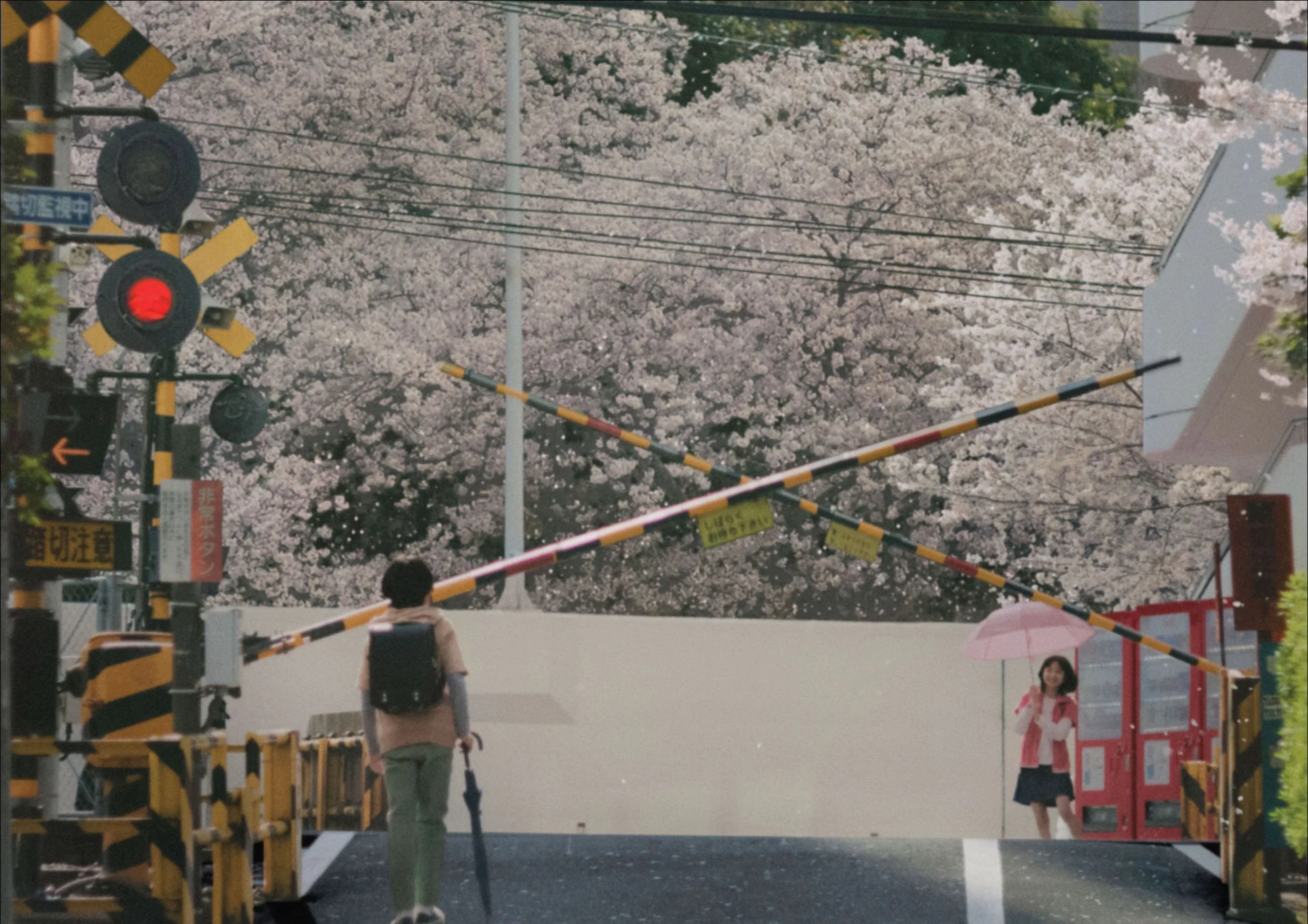
Life partners at 6
Where Shinkai broke up his mopey main character’s life into three distinct parts, Okuyama opts for a more streamlined, chronological construction that sees Takaki Tono (SixTONES singer Hokuto Matsumura, Kyrie) reflecting on his life as an office drone (who… codes?), still obsessing about The Elementary School Love That Got Away. That would be Akari Shinohara (Noa Shiroyama), who he met as an equally awkward and lonely transfer student (Haruto Ueda is young Takaki) and who he bonded with over a shared love of astronomy and a space shuttle launch in 1991. They become besties, and the day Akari has to move away with her family is a devastating one for Takaki. So he gets on the JR to see her one last time – a train trip that formed the bulk of the original animation – they kiss near a tree and promise to meet again at this same tree when a comet makes its return trip through our solar system in 2009.
In between making that childhood promise and comet day, Takaki (Yuzu Aoki is the teenaged version) grows into an insular and sullen high school kid who, for reasons, Kanae (Nana Mori, Kokuho) is into. But his heart is with Akari, so he blows her off. Later as an adult approaching that magic 30, another woman out of his league, Midori (Aoi Miyazaki), puts up with him enough to call him boyfriend, but he’s distant and unavailable. While he’s navel-gazing and trying to look romantically morose, the adult Akari (Mitsuki Takahata, also Kokuho) is adulting, working in a Kinokuniya and getting married to a dude unafraid to make eye contact. Takaki and Akari cross paths like ships in the night at the planetarium when he takes a new job – finally moving fucking forward – and the drama (such as it is) lies in whether or not they’ll reunite at The Tree.
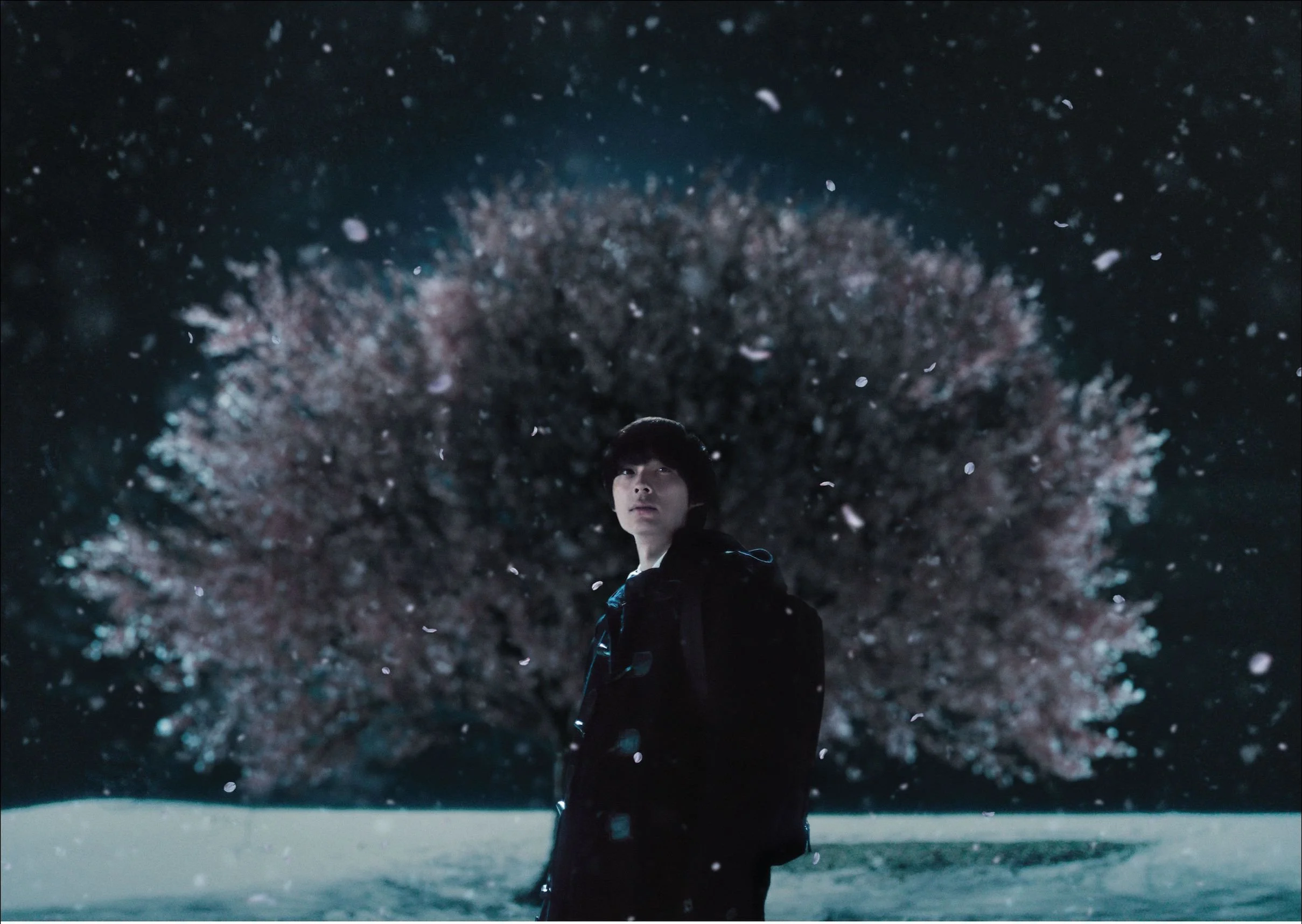

The title refers to how fast cherry blossom petals fall, which might also be a hint at about how fast this movie moves. Not that a meditative examination of personal stagnation, of how emotional connection is hard and not always found (like a space shuttle looking for alien life… that shuttle is a motif) and of how meaningful relationships can be as fleeting as a shooting star – or a comet. Yeah, 5 Centimeters Per Second isn’t exactly subtle, but given that so much of the film is filler it’s not surprising. Where Shinkai traded in ambiguity and existing in the liminal, in expanding the brevity that made that film such a lovely shot of mezcal, Okuyama has no choice but to focus on how Takaki is backward-looking, how he’s anchored in a youth he’ll never recover and turn the film into a pint that gets flat and warm. It’s another demo of infantalising of adult emotion, particuarly in men, that’s become a recurring theme in Japanese romances; a fixation on inexperienced, immature youth as some sort of ideal that should be recaptured or restored at all costs. WTF is going on and why is this perpetually a thing? Because Akari’s just fine, thanks, and I’m not even going to pretend otherwise. And for the extra 60 minutes heaped on the story’s modest skeleton we never even get an idea of what Takaki’s deal is, and why we should empathise with his peculiar ennui. Matsumura is tasked with the heavy lifting, and he’s fine behind his bangs, but he was better in All the Long Nights, where he actually had an arc. All this inaction unfolds under Okuyama’s blanket of admittedly striking film stock vibe images that, if nothing else, prove he’s mastered the language of contemporary baffling squish.