
Lawless
Wait, you mean this is a period piece?
Two Prosecutors
Director: Sergei Loznitsa • Writer: Sergei Loznitsa, based on the novella by Georgy Demidov
Starring: Aleksandr Kuznetsov, Aleksandr Filippenko, Anatoliy Beliy
Netherlands / France / Germany / Latvia / Romania • 1hr 57mins
Opens Hong Kong May 21 • IIA
Grade: B+
It’s 1937, the Second World War is two years away, and the Soviet Union’s great strongman Joseph Stalin is in the grips of his three-year Great Purge – the systematic removal of political dissenters from the Communist Party and any policymakers who disagreed with Stalin. The People's Commissariat for Internal Affairs, the NKVD (the secret police), did the dirty work, and eventually (inevitably?) the purges spread to include ranking army officers, arts and cutlural actors, anyone with a bit of wealth (it’s the Soviet Union after all) and random civilians, critical or otherwise. Nasty interrogations, prison and torture kept everyone in line and fearful, and led to (by some estimates) one million deaths.
It’s under these circumstances that slightly naïve, entirely idealistic young state prosecutor Kornyev (Aleksandr Kuznetsov, Amazon slop Heads of State), fresh out of law school, springs into action when he reads a letter written by an imprisoned old Bolshevik (also targets) and First World War hero, Stepniak (Soviet acting vet Aleksandr Filippenko), claiming to be a victim of abuse at the hands of the NKVD, who also persistently deny his legal rights. He interviews the man, sees his wounds, and immediately heads to Moscow, hoping to get a meeting with Andrey Vyshinsky (Anatoliy Beliy), the country’s Procurator General. He hopes Vyshinsky will help him investigate the corruption, and after getting assurances, he heads home.
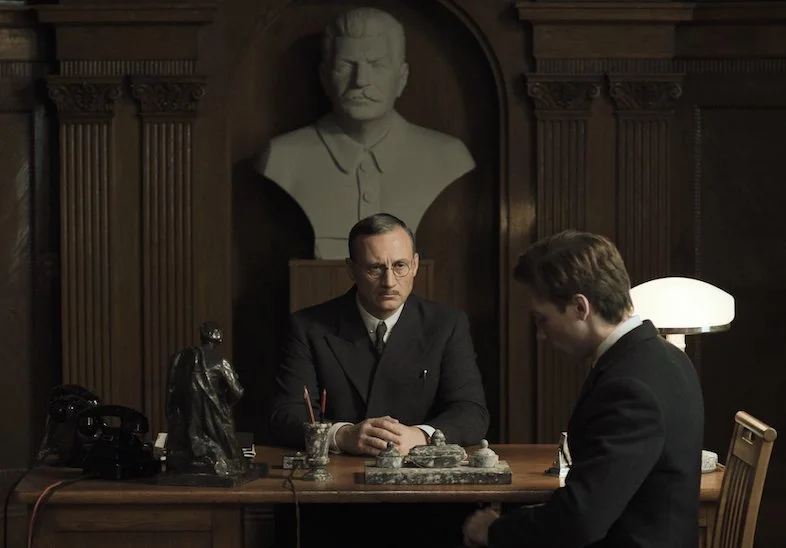
1937… or 2027?
Ukrainian-Belarusian director Sergei Loznitsa’s Two Prosecutors functions kind of like Apollo 13 or Titanic do, in that from jump we know how it’s going to end, but Loznitsa manages a creeping sense of menace to lace the film nonetheless. Based on the novella by writer and political prisoner Georgy Demidov, the film is a demanding one for its deliberate pacing and limited action, at least as wel know it. Two Prosecutors has a stagey feel, helped along by Loznitsa unfurling the story in basically four scenes: Kornyev’s visit to the Bryansk prison and the stonewalling warden, his in-cell interview with Stepniak, his meeting with Vyshinsky in Moscow and a doomed train ride home. There are a handful of scenes that stitch these main segments together – hallways, waiting rooms, walks thorugh a courtyard, that kind of thing – but that’s all they are, the format’s need to get its characters from one scene to the next. They do little to detract from the film’s theatrical tone and oppressive tension, which is tinged with disappointment, regret and disillusionment. You know what check that. We knew definitively how Apollo 13 and Titanic ended, which is what made the suspense surprising. In Two Prosecutors, with the weight of history bearing down, we’re pretty sure we know where Kornyev is heading, but the faintest hope still swirls around us, the hope that someone in a position of power will do what’s right. That’s what makes the inevitable closing shots so gutting.
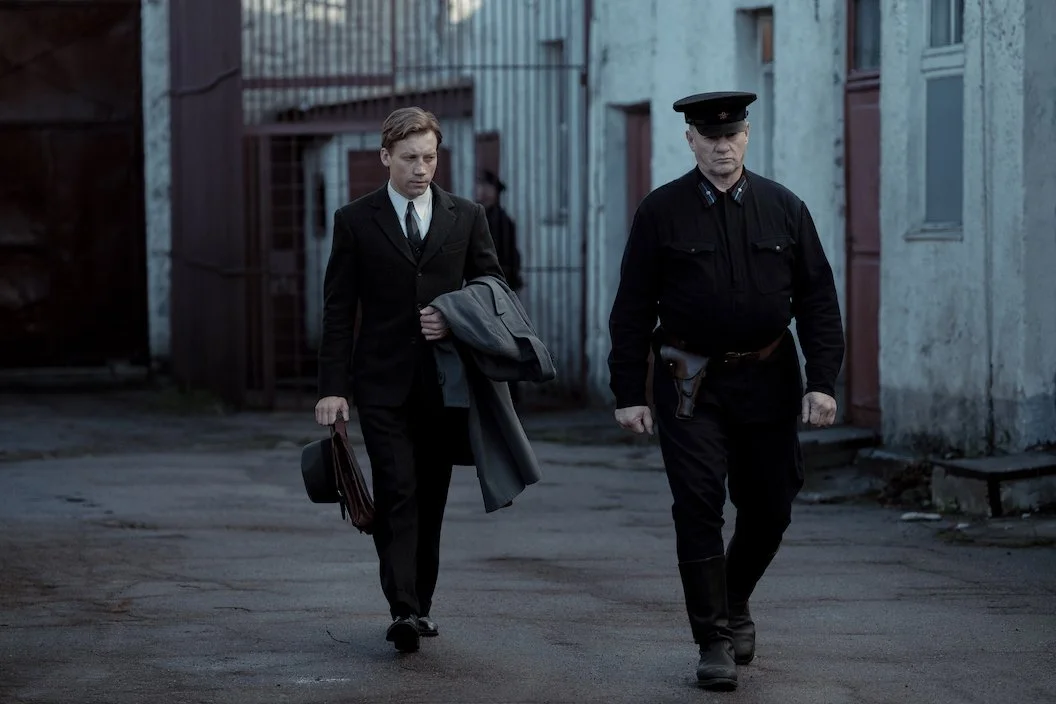

If someone were to make a faithful adaptation of Crime and Punishment now, it might have Two Prosecutors’ visual signature. Young production designers Aldis Meinerts and Yuriy Grigorovich and DOP Oleg Mutu (4 Months, 3 Weeks and 2 Days) blur the fine line between idealism and naïvete, submerging the imposing spaces – the prison and the legal building are equally discombobulating – Kornyev navigates in institutional grey and concrete, his perfectly pressed suit reflecting a respect for the law that no one else he encounters seems to share. This is a restrained film in Kuznetsov and Beliy’s meticulously placid performances as well as in direction, where the cautionary tale is teased out in familiar dribs and drabs. At one point Stepniak laments (short version) a system that places more value in grifters than in expertise, a sentiment that’s being turned over in millions of heads every day as we speak. So when Kornyev gets on the train home and meets a pair of overly-friendly passengers who insist on having a few drinks, we know it’s time to bail on that shred of hope we had. Two Prosecutors is simultaneously of its time yet timeless, and that makes it essential viewing you may not want to see.